
Clients & capability · Essay 128
How AI Is Changing the Way American Sales Teams Build Customer Trust
The Accidental Salesman Editorial Desk · 6 min read · Published 17 November 2026
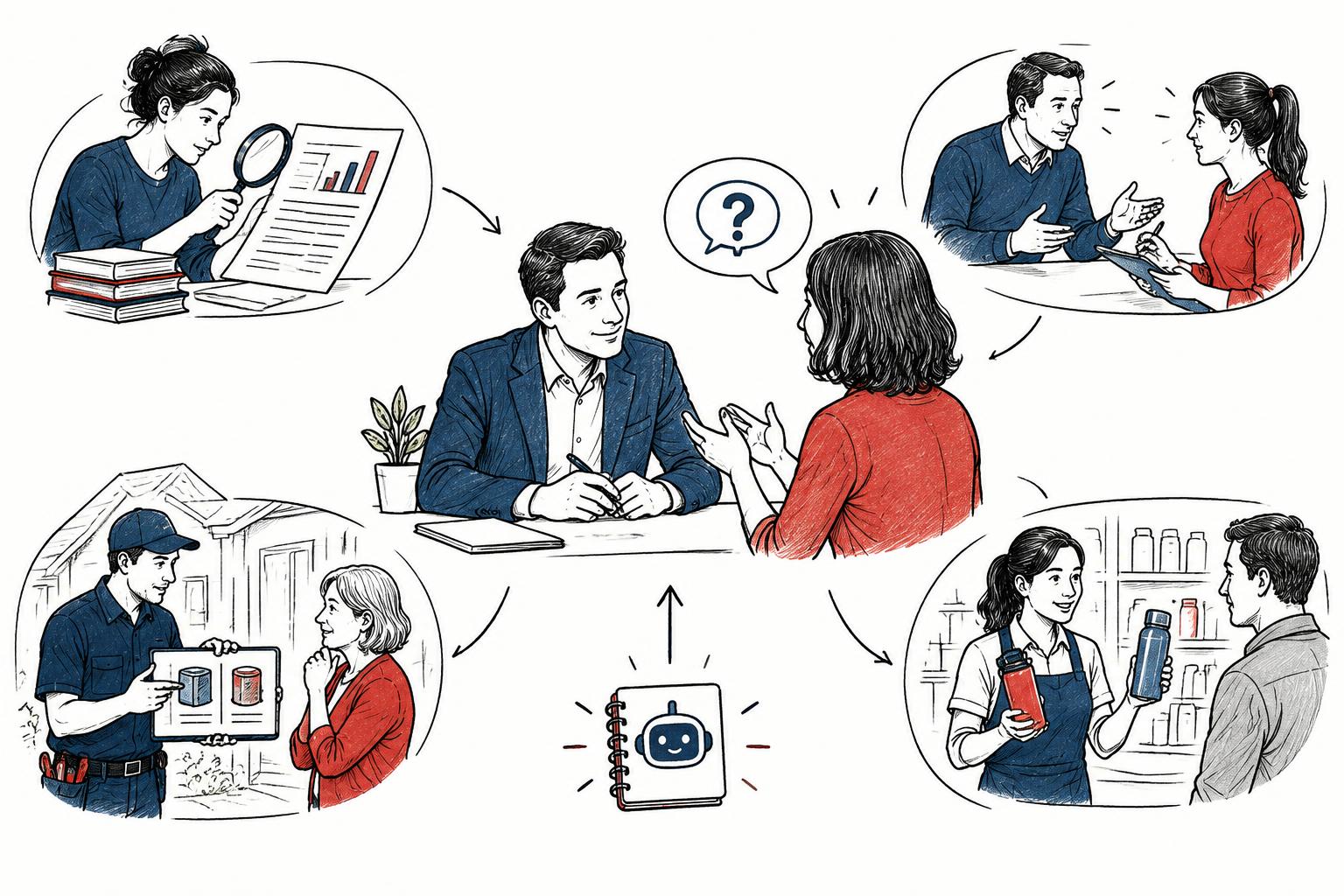
A customer asks whether your service can handle a tight deadline. Your AI-assisted draft says yes. Your operations team has not confirmed it. The message sounds helpful, but the relationship is already on shaky ground.
That is the central choice facing American sales teams: use AI to sound more attentive, or use it to become more attentive. Research summaries, rehearsal and better-organized notes can support the second approach. None removes the salesperson’s responsibility to listen, check facts and keep promises. The examples below are hypothetical, not reported customer experiences.
Trust still rests on what happens after the pitch
Customers want to know whether a recommendation fits and whether the seller will deliver. Trust does not mean every deal closes. Doney and Cannon’s research on industrial purchasing linked supplier trust with anticipated future interaction, but found no effect on current supplier selection after controlling for experience and performance [R161]. Reliability matters; it is not a shortcut around commercial reality.
Listening belongs in that picture. A sales-focused meta-analysis links listening with adaptive selling and relationship and performance outcomes [R9]. These are not findings about AI. They point toward the behavior AI should support: understanding the buyer before deciding what to say.
Research the prospect without inventing the customer
AI can help organize approved account records, public company information and prior conversation notes into a preparation brief. Ask for three columns: verified facts, possible implications and unanswered questions. Require a source and date for each factual claim. A company expansion is not proof that a particular contact has budget.
For a B2B packaging supplier, public news about a new warehouse might suggest asking about shipping requirements. The useful opener is, “Has the new location changed what you need from packaging?” It is not, “I know your current supplier cannot keep up.” Preparation should produce better questions, not imaginary inside knowledge.
Personalize around the concern, not the profile
The strongest detail often comes directly from the customer. A retail shopper says a jacket must work for a rainy commute. An assistant can help compare approved product specifications; the associate still needs to explain waterproofing, care requirements and tradeoffs accurately.
In home services, a homeowner may care more about disruption than the lowest quote. Use their stated concern to prepare a clear access plan, not a warmer version of the same pitch. Avoid unexplained personal details: consumer advertising research associates covert information collection with vulnerability in personalized advertising [R108]. Applying that caution to sales is editorial judgment, not a measured AI-sales effect.
Rehearse the hard conversation before a customer has it
AI-powered roleplay can provide a simulated buyer who questions price, hesitates over risk or challenges a recommendation. Give the exercise approved product facts and one skill to practice. Ask the simulated buyer to withhold the underlying concern until the salesperson explores it.
A roofing representative could practice responding to, “Another contractor quoted less.” The goal is to ask what is included, explain verifiable differences and avoid unsupported claims about competitors. Repeat after specific feedback. Behavior-modeling training research supports examining learning and workplace transfer, but does not validate AI roleplay scores or guarantee sales gains [R155].
Let AI suggest coaching opportunities, not verdicts
With appropriately collected records, managers can use AI to flag possible missed questions, unclear explanations or unconfirmed next steps. Treat each flag as a place to look. Check the original context before telling a representative what went wrong.
For a commercial-cleaning team, several conversations might reveal that reps discuss frequency without asking about access restrictions. Coach that specific gap, rehearse it and review whether the questions improve. Do not label someone a weak salesperson because an opaque score dislikes their accent or conversational style.
Keep judgment, empathy and product knowledge with people
A fluent answer is not necessarily an informed recommendation. Salespeople need to understand eligibility, limitations, pricing and delivery well enough to challenge an AI suggestion. NIST’s generative AI profile identifies risks including confident false output, privacy problems and problematic human reliance [R103].
Empathy also means adjusting the process. A customer worried about a repair bill may need options and time, not another persuasive paragraph. An account with an unresolved service complaint needs ownership of the problem before a renewal pitch. AI can recover the history; a person must decide what a fair response requires.
Avoid the mistakes that turn assistance into distance
Three habits are particularly risky: sending drafts without checking material claims, treating inferred intent as confirmed need, and continuing automated outreach after a customer asks to wait. Another is preparing so thoroughly that the rep stops hearing new information.
Before sending, check every price, date, guarantee and description of the customer’s situation. During the conversation, allow the buyer to correct your understanding. Afterward, record the agreed action and timing. A polished message that ignores the last conversation is still a poor follow-up.
Make responsible data use part of the routine
Use approved tools and only the information needed for the task. Remove identifying details from practice scenarios where possible. Check access, retention, deletion and whether providers may use submitted data for model training [R103]. Do not paste confidential customer records into an unapproved account.
For recordings, automated outreach and sensitive information, obtain guidance on the applicable US channel, state and industry requirements. Do not assume one customer permission covers every use. If an automated assistant speaks directly with buyers, identify its role and offer a workable route to a person.
Four questions sales teams ask
Can AI replace relationship-building? It can assist with preparation and follow-through, but it cannot accept responsibility for the offer. Keep an accountable person available for questions and problems.
What is a sensible first use? Start with a checked pre-call brief or a follow-up drafted from approved notes. Choose a narrow task where a reviewer can readily spot mistakes.
How should we evaluate AI coaching? Look for better questioning, accurate explanations and appropriate next steps in real work. Simulation scores alone do not establish customer trust or sales improvement.
How do we know whether customers benefit? Track repeated clarification requests, missed commitments, complaints and buyer-confirmed next steps alongside commercial outcomes. Faster drafting is useful only if the total review burden and customer experience also make sense.
Use the saved time to pay closer attention
The practical test is simple: does assistance help your team understand customers and follow through more reliably? If it merely increases output, reconsider the workflow. Let AI carry some preparation. Let people remain responsible for the conversation, the recommendation and the promise.
Put it to work
A practical next step
Choose one recurring conversation. Prepare a source-checked brief, rehearse one difficult question and have a manager review the response. In the next customer conversation, check your understanding aloud and agree on a next step. Review accuracy and follow-through before expanding AI use.
Proposed practice, not a completed experiment. Illustrations are not client testimony.
Sources & limits
Publisher abstract accessed through indexed text: study of more than 200 purchasing managers. Supplier trust and indirectly salesperson trust relate to anticipated future interaction; neither predicts current selection after controls for experience and performance. Historical industrial-buyer evidence, not an AI experiment or a universal causal estimate for US retail or home services.
Meta-analysis of 117 training studies, with effects differing across learning, job behavior and business results. Not an AI sales-roleplay trial, field-sales conversion estimate or validation of a vendor; recommendations are editorial applications of the abstract.
Voluntary cross-sector risk guidance on confabulation, privacy and automation bias; not a sales-specific law, certification or guarantee that reviewed AI output is accurate.
Consumer advertising research on information collection, vulnerability and personalization. Its implications are editorially adapted, not direct causal estimates for AI-generated sales follow-ups.
Meta-analytic model of salesperson listening; associations and synthesized relationships do not establish that an example email causes better outcomes.
Editorial synthesis published 17 November 2026. Research is linked above; examples and the practical exercise are editorial applications, not reported outcomes.