
Tools & judgment · Essay 114
Are Foldable Phones Worth Buying in the US?
The Accidental Salesman Editorial Desk · 10 min read · Published 27 October 2026
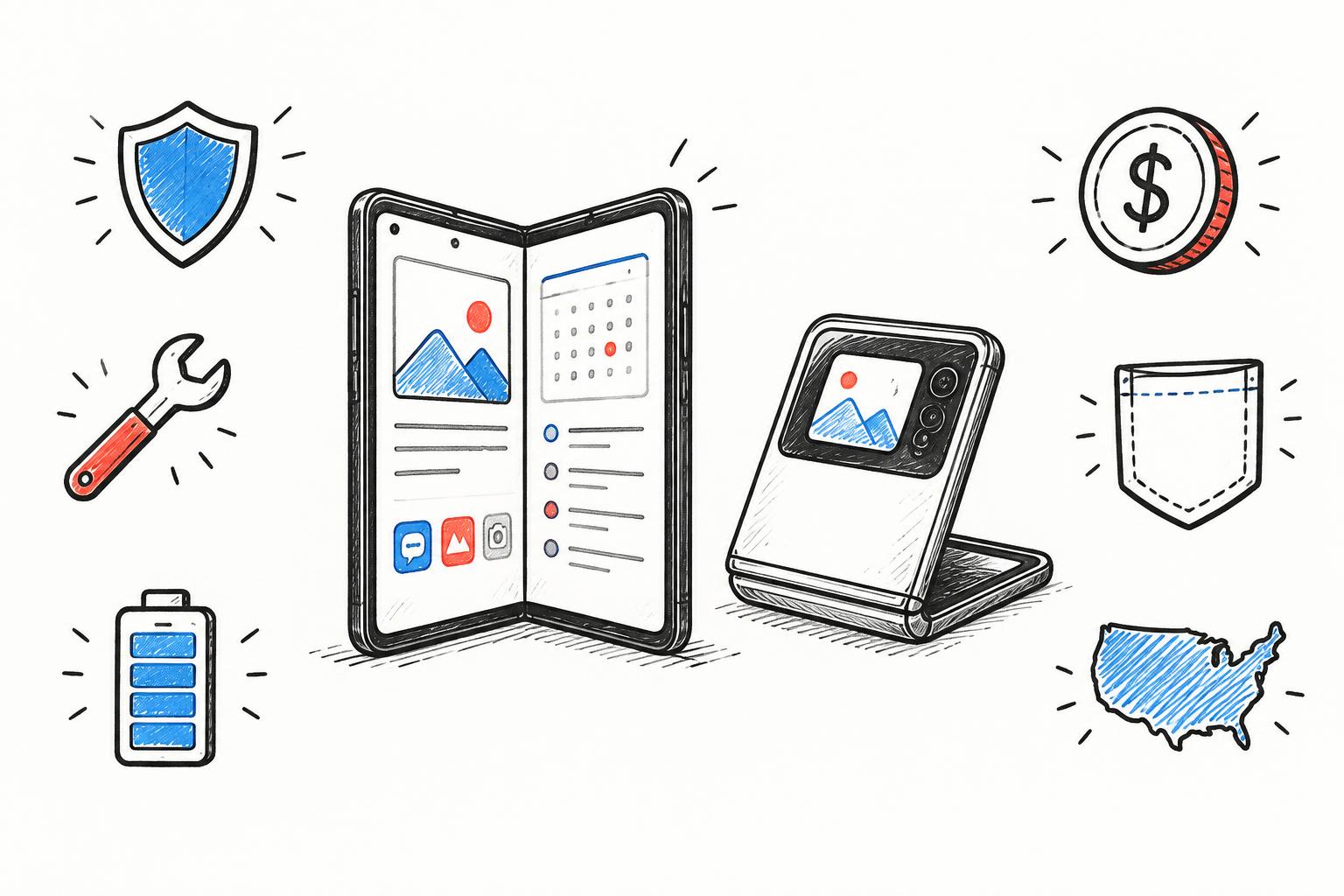
Yes—foldable phones can be worth buying in the US, but only when the folding design solves a recurring problem you actually have. A book-style phone can make reading and working across two applications more comfortable. A flip phone can put a full-size smartphone into a shorter pocketable shape. Neither benefit automatically justifies a higher bill, a more delicate inner display or a financing agreement that outlasts your enthusiasm.
For most buyers who simply want reliable calls, strong photographs, good battery life and uncomplicated ownership, a conventional smartphone remains the safer default. That is an editorial recommendation, not a claim that every foldable is unreliable. This guide examines manufacturer specifications, official care and support information, and US buying considerations. We have not performed a laboratory comparison or a long-term reliability trial, and the model examples below are documented reference points—not a claim to rank every October 2026 release.
1. Book-style or flip: two different reasons to fold
A book-style foldable opens sideways into a larger workspace. Its outer display handles quick tasks; its inner display is the reason to pay more. Reading a document beside an email, checking a calendar while composing a message, or inspecting a map with more context are plausible benefits. Whether they help depends on the application layout and your willingness to unfold the phone repeatedly.
A clamshell flip phone instead folds a tall screen into a shorter package. Its value is portability and, where the exact model supports it, quick interactions on an outer screen or hands-free camera positioning. Do not buy one expecting a tablet-sized workspace. Also try it in your actual pocket: shorter when closed does not necessarily mean thinner or easier to carry.
Samsung’s published comparison illustrates the distinction: the Galaxy Z Fold7 has an 8.0-inch main display and a 6.5-inch cover display, while the Z Flip7 has a 6.9-inch main display and a 4.1-inch cover display [R34]. Those diagonal measurements are manufacturer specifications, not a measure of useful space in every application. Aspect ratio, controls and keyboard placement matter just as much.
2. When the larger screen earns its premium
The strongest case for a book-style phone is frequent use away from a desk. A consultant reviewing a proposal between appointments or a traveller comparing reservations with a map might benefit from the extra display. These are illustrative use cases, not measured productivity gains. A larger screen is valuable only if it removes friction from work you already do.
Before buying, open the applications you actually depend on. Try a PDF with small print, your preferred messaging tool, a spreadsheet and two applications side by side. Check whether text becomes easier to read, whether the keyboard obscures the useful content and whether an application stretches awkwardly rather than adapting. Ask your employer about device-management and work-profile compatibility if the phone will carry business information.
A foldable is not automatically a laptop replacement. Precise spreadsheet work, long writing sessions and specialist software can still need a keyboard, pointer or desktop operating system. Nor is it always a tablet replacement: you may prefer a separate screen for reading while leaving your phone available for calls. Compare a conventional phone plus the tablet you already own before buying a combined device.
3. Durability: more capable does not mean carefree
A hinge and a flexible inner display introduce care requirements that a rigid-screen phone does not share in the same way. The screen’s crease is not, by itself, evidence of a defect; it is part of the design you should inspect under different lighting. What matters is whether you find it distracting and whether the phone’s operation, panel and hinge are in good condition.
Samsung lists IP48 for the Fold7 and Flip7 [R34]. Do not read that as “dustproof” or unrestricted protection against water. The solid-particle and water portions of an ingress rating mean different things, and the manufacturer’s exposure conditions and warnings still apply. A beach, a dusty workshop and a pocket full of grit are not equivalent to a controlled water-resistance test.
Follow the exact model’s care instructions: keep debris away from the hinge and display, avoid pressure from sharp objects and do not treat a factory-applied inner screen protector like a disposable accessory to peel off casually [R35]. If the protector lifts or the display develops a problem, consult the approved service route rather than improvising a repair.
Published hinge-cycle claims or promotional durability statements cannot tell you the probability of your phone surviving a drop or several years of everyday wear. We do not have a representative, independently verified US failure-rate dataset for the models discussed here. If your work involves dust, repeated drops or rough handling, the uncertainty and care burden may outweigh the folding benefit.
4. Repair and protection plans can change the decision
Before checkout, obtain a repair estimate for the inner display, outer display and battery of the exact model. These are different jobs and can have different prices. Ask where repairs happen, how long you might be without the phone and whether an authorised local option exists. A technically repairable device is not necessarily economical or convenient to repair.
Separate the manufacturer’s warranty from accidental-damage coverage. A warranty, a retailer protection plan and a manufacturer care subscription are not interchangeable. Check covered events, service fees or deductibles, claim limits, exclusions and cancellation terms. Samsung publishes model-specific screen-repair information and separate Samsung Care+ terms [R36, R37]; the amount you actually owe depends on the device, coverage and applicable conditions.
Include the cost of being without your main authentication device. Make sure you can recover important accounts, access travel bookings and move essential information to a replacement. That is an ownership consideration rather than a reason to buy more insurance. If a single repair would make the phone unaffordable, a lower-cost conventional model may fit your budget better.
5. US carrier promotions: compare the whole commitment
A dramatic trade-in offer can make an expensive phone look inexpensive. The important distinction is an immediate reduction in price versus credits delivered over a financing period. Read the actual offer, not merely the advertised monthly device payment. Confirm the required plan, eligible trade-in condition, credit schedule, taxes, activation charges and what happens if you switch carriers or pay off early.
Compare total ownership cost over the same period: device payments minus credits you realistically expect to receive, any extra service-plan cost, tax and fees, protection premiums and necessary accessories. Do not count speculative resale value as guaranteed savings. A promotion that requires a more expensive plan can offset much of the apparent hardware discount.
This article deliberately does not advertise an unverified live price or call any promotion the best deal. US offers change, and your existing plan and trade-in eligibility can change the outcome. Get a written checkout breakdown from both the carrier and an unlocked-device seller. Buying the lowest advertised monthly payment is not the same as buying the lowest total cost.
6. Compatibility and update support need exact-model checks
For US use, confirm the specific regional model is accepted by your carrier. Check its compatibility tool and, where available, the device’s IMEI before purchase. “Unlocked” does not by itself establish that every carrier feature will work. Verify eSIM or physical-SIM requirements, Wi-Fi calling, international use and any unlock restrictions that apply to the seller’s version.
Imports can create additional uncertainty around carrier certification, warranty service and replacement parts. A phone sold overseas may share a product name while differing in radio support or service eligibility. Check these issues before paying a discount that you may later spend on workarounds.
Software support is a remaining-life question. Google states that Pixel 9 Pro Fold receives seven years of OS and security updates from its first availability on the US Google Store—not from each buyer’s purchase date [R38]. This is a documented example, not a blanket promise for every foldable. For any candidate, find the exact published commitment and its starting point; an older discounted model has already used part of its support window.
7. Cameras, battery life and AI: evaluate separately from the hinge
Folding is a form factor, not a camera-quality certificate. Samsung lists different camera systems for Fold7 and Flip7, including a 3x optical telephoto on Fold7 and digital zoom on Flip7 [R34]. That difference may matter to a buyer who photographs distant subjects, but specifications alone do not establish low-light quality, moving-subject performance or the photographs you will prefer.
Battery capacity also does not settle endurance. Display size, brightness, connectivity, applications and time spent unfolded all influence the result. Look for independent testing with a disclosed method for the exact model, then check whether that method resembles your day. Manufacturer “up to” figures are conditional, not a guarantee of time between charges for you.
Treat AI features as a separate buying decision. Check language and regional availability, whether processing is local or cloud-based, privacy controls and any ongoing cost. A summarisation feature does not become accurate merely because the display is larger. If you handle client material, follow your organisation’s information policies and verify generated answers against the original.
8. Older, refurbished and used foldables: savings with extra inspection
A previous-generation foldable may make more sense than a flagship launch purchase, but condition matters. Inspect the inner panel under bright and dark backgrounds, touch response near the fold, hinge movement, both cameras and charging. Look for unusual lines, bubbling, damage and unexplained repair history; do not assume a seller’s generic “excellent” grade answers these questions.
Ask about battery condition, original screen-protector status, authorised repairs, account locks, outstanding financing and return rights. Check whether the warranty or protection plan transfers. A photograph of the outer screen is not enough to evaluate the inner display.
For a purchase you cannot inspect in person, a clear return route and meaningful written coverage can matter more than a small extra discount. We do not assume any particular remaining lifespan for a used foldable. If the seller cannot resolve important condition or ownership questions, treat them as risks rather than reasons to hurry.
9. A practical buying test before committing
Use a store demonstration or a permitted return window to test a short list of real jobs. Read one difficult document. Compose a message while consulting another application. Make a photograph you commonly take. Use the outer screen for a quick task. Check carrying comfort with the case you expect to use. Do not upload private work materials to a demonstration device.
Record which tasks are genuinely easier and which are no different from your current phone. For a book-style model, ask how often you would unfold it. For a flip, ask whether compactness outweighs the extra opening action and any outer-screen restrictions. These are proposed personal checks, not scientific performance measurements.
Then write down the full cost, remaining support window, repair route, coverage terms and your reason for choosing the folding design. If the reason remains “it looks interesting”, that can still be a legitimate discretionary purchase—but it should be funded as enjoyment, not justified with invented productivity savings.
10. The verdict: buy the benefit, not the novelty
A book-style foldable is worth shortlisting when you regularly need a larger mobile workspace, the applications you use behave well on it, and you can comfortably afford the complete ownership cost. A flip is worth shortlisting when compact carrying and its specific camera or cover-screen conveniences matter more than maximising hardware value.
Choose a conventional phone when your priority is straightforward ownership, when you seldom need a second screen, when your environment is rough on devices or when one uncovered repair would strain your budget. Keeping a supported phone that already meets your needs is another valid outcome.
The sales lesson is the same as the buying lesson: demonstrate the customer’s actual task, explain the compromises and disclose the financial conditions. A useful recommendation makes the trade-off clear. Foldable phones are not a universal upgrade; they are a particular solution that becomes valuable when the right buyer has the right recurring problem.
Put it to work
A practical next step
Compare one book-style foldable, one flip and one conventional phone using the same three daily tasks. Record US carrier compatibility, remaining update support, checkout cost, required plan changes, repair options and accidental-damage terms. Choose only after identifying a concrete benefit worth the additional cost and care. This is a proposed personal buying assessment, not a completed experiment.
Proposed practice, not a completed experiment. Illustrations are not client testimony.
Sources & limits
Manufacturer specifications, not independent camera, battery or reliability testing. This guide cites Fold7 and Flip7 figures; model-specific IP ratings and exposure warnings must be checked separately.
Manufacturer handling and screen-protector guidance. Controlled water-resistance conditions do not establish accidental-damage coverage or a real-world failure probability.
Official service information. Suggested prices vary by model, repair location and applicable fees; no specific repair quote or turnaround guarantee is asserted here.
Manufacturer protection-plan information, not an endorsement. Eligibility, premiums, service fees, covered events and exclusions depend on the applicable plan terms.
Official support commitment: seven years for the listed Pixel 8 and later phones, including Pixel 9 Pro Fold, counted from first US Google Store availability. Not seven years from a later purchase or a promise of hardware longevity.
Editorial synthesis published 27 October 2026. Research is linked above; examples and the practical exercise are editorial applications, not reported outcomes.