
Tools & judgment · Essay 115
Why Big Tech Companies Are Building Their Own Chips
The Accidental Salesman Editorial Desk · 12 min read · Published 28 October 2026
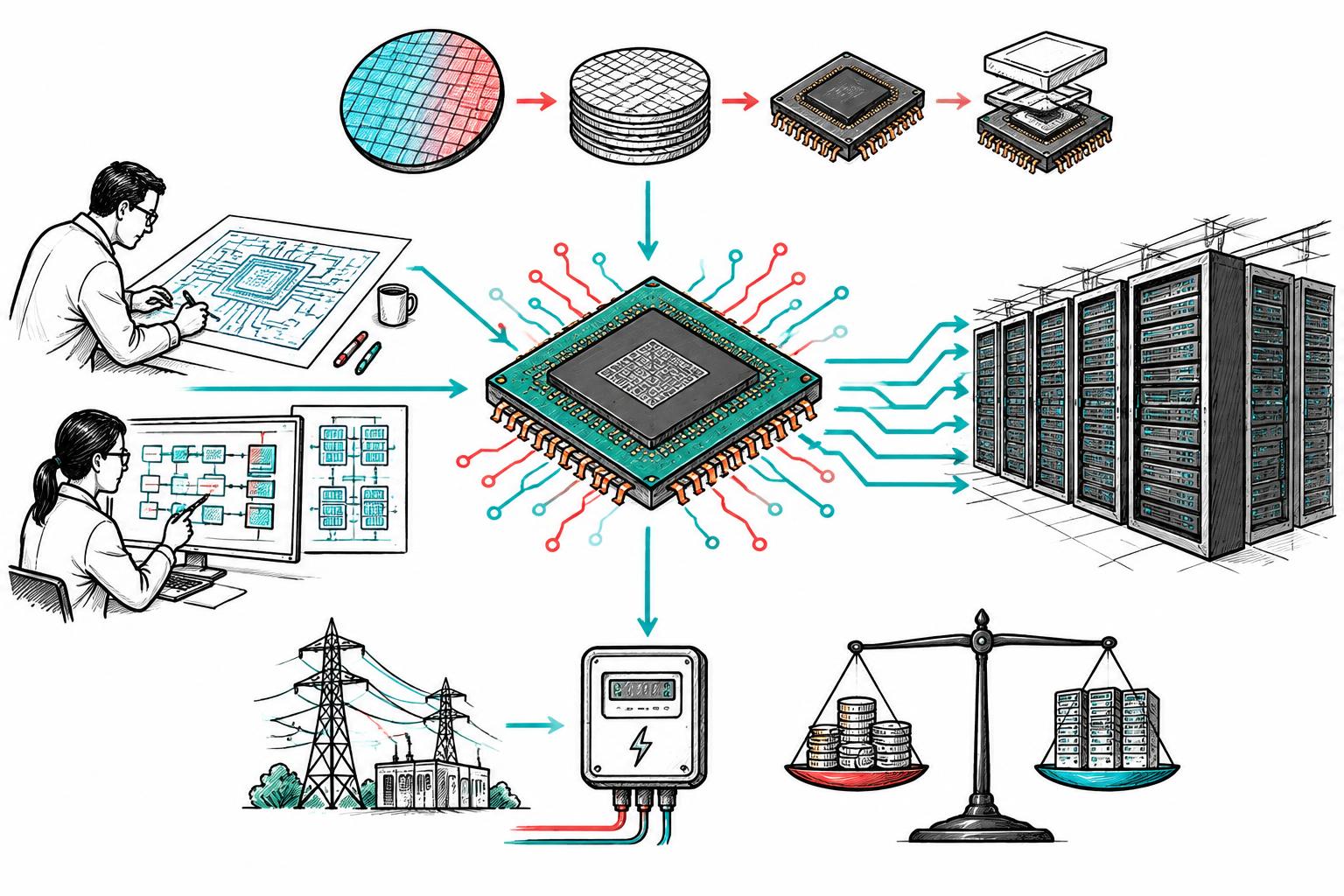
Big technology companies are building their own chips because computing has become both a defining product capability and a major operating expense. When a business runs enormous numbers of similar tasks, even a modest improvement in the cost or energy required for each useful result can matter. Designing a processor around those tasks gives the company another way to influence performance, capacity and the economics of its services.
But “building their own chips” rarely means making semiconductors entirely themselves. It usually means designing custom silicon, sometimes with external partners, and commissioning specialist manufacturers to fabricate and package it. Nor does it mean that Google, Amazon, Microsoft or Meta can simply abandon established chip suppliers. The more accurate story is selective integration: control more of the computing stack where scale and predictable workloads justify the investment, while continuing to buy hardware where external platforms remain useful.
This article draws on official engineering announcements and company disclosures. It separates documented product purposes from vendor performance claims and from our economic interpretation. It is not a hands-on chip comparison, an estimate of confidential development budgets or a claim to cover every processor announced by October 2026.
1. Custom processors are not all the same thing
A general-purpose CPU handles a broad range of instructions and operating-system work. A GPU provides highly parallel processing and has become central to many AI workloads. A purpose-built accelerator instead concentrates resources on selected computations. In machine learning, that often includes the matrix operations used in training and inference. These categories can work together within one server rather than compete for every job.
A system-on-chip integrates several functions into a design. Apple’s M1 announcement, for example, describes CPU, graphics, machine-learning and other capabilities combined with a unified memory architecture [R45]. That is a product-integration strategy, not the same engineering problem as running a large AI training cluster. Both count as custom silicon, but they earn their value in different ways.
The defining question is not whether a chip is “custom” but what it is customised for. A processor optimised for web services may not be the best choice for training a language model. An accelerator built for recommendation inference may need different memory, numerical precision and networking from one built for experimental frontier-model training. Specialisation exchanges some flexibility for a better fit to a known workload.
2. Scale makes small improvements economically important
A small organisation normally benefits from buying broadly available hardware or cloud capacity. It avoids the fixed costs of architecture design, verification, software development, manufacturing preparation and support. A large platform company has a different calculation: it can spread those fixed costs across many machines and years of recurring work.
The potential reward is not simply a cheaper physical chip. It is a lower cost per completed task at the quality and response time the service requires. For an AI system, the relevant task might be a training run or an inference response. For a cloud CPU, it might be an application request. For a recommendation system, it might be ranking candidates within a strict latency limit.
Custom designs can avoid paying—in silicon area, energy or system complexity—for capabilities a particular workload rarely uses. They can also coordinate memory, networking and software more closely. None of that guarantees savings. A narrowly optimised chip that arrives late, runs at low utilisation or requires extensive workarounds can be less economical than a flexible third-party platform.
3. Google and Amazon: different workloads, different silicon
Google’s Tensor Processing Units illustrate sustained investment in AI-specific acceleration. Its 2024 Trillium announcement describes a sixth-generation TPU and reports improvements in compute, high-bandwidth memory and inter-chip bandwidth compared with TPU v5e [R39]. Those architectural dimensions matter because an accelerator must feed its arithmetic units and communicate with other chips, not merely advertise a large peak-compute number.
Amazon’s approach includes more than AI. The original AWS Graviton announcement describes an Arm-based custom CPU for scale-out workloads such as web servers, microservices and caching [R40]. Trainium addresses another part of the portfolio: AI training and inference. AWS’s Trn2 announcement describes Trainium2-based instances and larger connected systems [R41]. A portfolio makes sense when a cloud serves many different jobs.
AWS reports 30–40% better price-performance for Trn2 than the specified GPU-based P5e and P5en instances in its announcement [R41]. That is an AWS comparison of particular cloud offerings, not proof that Trainium always costs less than every GPU. The customer still needs to examine model support, software migration, utilisation, latency and the actual commercial terms. An advertised instance advantage can disappear if the application does not use the hardware effectively.
4. Microsoft, Meta and Apple: own the part that shapes the service
Microsoft describes Maia 100 as its first in-house AI accelerator, developed for cloud AI workloads with a silicon-to-software-to-systems approach [R42]. Its rationale is broader than replacing a component on a purchasing list: architecture, server design and software can be coordinated around the services the company operates. The same disclosure identifies external manufacturing and packaging, demonstrating that custom design still depends on specialist partners.
Meta’s MTIA work began with the requirements of deep-learning recommendation models. Its 2024 infrastructure announcement places custom inference acceleration within a larger infrastructure programme [R43]. In March 2026, Meta explicitly describes a portfolio that combines its own silicon with industry suppliers [R44]. That is evidence against the simplistic claim that internal chips mean an immediate exit from third-party processors.
Apple shows the consumer-product version of the strategy. With M1, it could align Mac hardware with its operating system, applications and power-management goals [R45]. A laptop buyer may experience the value through responsiveness, battery use or a device’s physical design rather than a data-center cost calculation. Apple’s example should not be treated as a benchmark proving that the same integration choices win in every cloud workload.
5. Supplier dependence: diversification rather than independence
Buying processors means accepting part of a supplier’s roadmap, pricing, capacity allocation and software ecosystem. Nvidia, AMD and Intel supply different combinations of processors, accelerators and platforms; they are not interchangeable dependencies. A company designing an alternative gains an additional option for selected workloads, which can improve planning flexibility and potentially strengthen its negotiating position. The negotiating benefit is an economic interpretation, not a disclosed contract outcome.
Third-party platforms retain value because of their broad capabilities, software tools, developer familiarity and support for changing workloads. The work required to move an application can be substantial. Framework compatibility, compilers, specialised kernels, debugging tools and distributed execution all matter. A design that looks attractive on a specification sheet may not yet support the operations a production model needs.
Custom silicon therefore changes where dependence sits. A platform may rely less on one accelerator family for a particular job while becoming more dependent on its own compiler team, external foundry capacity or a specialised packaging process. Independence is not a useful binary label. The practical question is which dependencies are reduced, which are introduced and how costly it would be to change direction.
6. Designing a chip does not remove manufacturing constraints
Architecture and physical manufacturing are separate capabilities. A fabless designer still needs a foundry to turn designs into working wafers, and it needs testing and packaging to produce usable components. Microsoft’s Maia account identifies a 5-nanometre process and advanced TSMC packaging [R42]. Owning the design does not give the customer its own semiconductor fabrication plant.
TSMC’s 2024 annual report describes demand and development around leading-edge logic and advanced packaging, including CoWoS, InFO and SoIC technologies [R46]. For AI systems, the package can be central to connecting compute with memory efficiently. A custom accelerator cannot be evaluated independently of the manufacturing and integration route required to deliver it.
High-bandwidth memory is another dependency for designs that use it. Memory capacity and bandwidth, package design, interconnects, networking and delivery schedules can constrain usable system capacity even when the logic design is sound. The cited disclosures do not establish a current shortage or an exact bottleneck for every company. They do establish why “we designed our own chip” should not be confused with “we control the entire supply chain”.
7. The economics: compare total cost per useful result
A disciplined comparison starts with the service requirement. What result must be produced, at what quality, response time and reliability? Only then can hardware be compared fairly. Peak operations per second are not useful savings if the model cannot achieve the required accuracy, the batch size is unrealistic or the response takes too long.
For an operator, total cost includes servers or contracted capacity, memory, networking, electricity, cooling, facilities, maintenance and the engineering effort required to run the application. A custom programme also carries design, verification, software and deployment costs. A cloud customer has a different view: the bill normally includes much of the provider’s infrastructure cost, so adding those same expenses again would double-count them. The customer should instead include instance charges, commitments, migration, operations and relevant transfer or storage charges.
A useful economic model divides the complete comparable cost over a defined period by the number of successful, quality-qualified tasks delivered in that period. Keep the definition of success identical across systems. For inference, report throughput together with response-time constraints and model quality; for training, compare time and cost to a comparable target outcome, not just one fast iteration.
Break-even depends on fixed investment, the realistic saving per task and how much qualifying work can be moved. The calculation should include uncertainty: development delays, lower-than-expected demand, software changes and the useful life of the hardware. This is a proposed decision framework. We do not have the confidential inputs needed to calculate a verified company-specific return on investment.
8. Utilisation, memory and power can outweigh headline speed
An expensive accelerator waiting for data is not delivering its advertised value. The limiting factor can be memory bandwidth, communication between machines, storage, scheduling or software. Faster arithmetic helps only when the rest of the system can keep it busy. The Trillium and Trainium2 disclosures discuss memory and connectivity alongside compute for precisely this reason [R39, R41].
Utilisation must be measured over real demand, not only during a benchmark. Inference services can face bursts, quiet periods and strict response-time requirements that limit batching. Training clusters may lose useful time to failures, checkpoints or orchestration. A highly specialised system can also be harder to redeploy when the workload changes.
Energy efficiency matters because power and cooling are operating costs and practical deployment constraints. However, a chip-level efficiency claim is not a whole-facility result. Google reports greater energy efficiency for Trillium relative to TPU v5e [R39]; that does not by itself establish your electricity bill or a company’s total emissions. More efficient work can coexist with higher overall energy use if the company runs much more computing.
9. Software is part of the chip investment
A production processor needs a usable software stack, not just functioning silicon. Compilers must map workloads effectively; libraries must support important operations; monitoring and debugging must make failures understandable. Engineers also need confidence that changing models will not repeatedly require expensive custom development.
The migration burden is asymmetric. A company that controls a large, repetitive internal workload may be able to redesign it around its own hardware. An external customer with varied applications, limited engineering capacity or third-party dependencies may prefer the broader compatibility of an established platform. The same chip can be economically attractive to its designer and unattractive to a particular customer.
There is also a portability trade-off. Moving away from one supplier’s software ecosystem can introduce dependence on a cloud provider’s accelerator tooling. Ask how models are exported, which operations are supported, what happens when a model changes and whether the team can maintain an alternative execution path. Lower compute charges are valuable, but not if switching costs remove every realistic alternative.
10. What buyers should ask before accepting a savings claim
Ask for the exact workload, model version, precision, batch size, hardware configuration, software stack and baseline behind a comparison. Require throughput and latency together where both affect service quality. Clarify whether a price-performance claim uses public pricing, a commitment discount or an internal cost estimate. These are different comparisons.
Run a bounded evaluation using representative, appropriately authorised data. Record quality, successful throughput, response-time distribution, failures, migration hours and the bill. Include quiet and busy periods if they are material to the application. Do not upload private customer material merely to test a chip platform, and do not treat a demonstration as a completed production trial.
For sales and procurement teams, the strongest proposal connects infrastructure choice to the customer’s actual constraints: cost predictability, delivery capacity, model compatibility, engineering time and recovery options. “Our chip is faster” is an incomplete argument. A credible recommendation states where the advantage was measured, what it costs to obtain and where an alternative remains preferable.
11. The bottom line: control the economics, not every component
Big Tech is designing chips because it has the scale, recurring workloads and software influence to make selective integration plausible. Custom processors can align hardware with service needs, create additional sourcing options and potentially lower the cost of useful computing. These are strategic advantages to pursue, not guaranteed outcomes simply because a processor carries an internal name.
The trade-offs remain substantial: fixed development investment, software work, manufacturing and memory dependencies, uncertain utilisation and the risk that workloads change before the design earns its cost. External chip suppliers remain important because flexibility, mature ecosystems and broad availability also have economic value.
The best way to understand this shift is not as a contest between “own chips” and “supplier chips”. It is a portfolio decision about which layer of the computing stack to control, which to buy and how to measure the result. The winning design is the one that delivers the required work reliably at an acceptable full cost—not necessarily the one with the most impressive headline specification.
Put it to work
A practical next step
Select one recurring compute workload and compare a conventional platform with one suitable custom-silicon option. Define equivalent quality and latency requirements, measure successful throughput and realistic utilisation, and estimate migration, operating and commercial costs over the same period. Record software gaps and supplier dependencies before recommending a move. This is a proposed evaluation protocol, not a completed benchmark or a promise of savings.
Proposed practice, not a completed experiment. Illustrations are not client testimony.
Sources & limits
Vendor architecture and performance disclosure relative to TPU v5e. Chip-level comparisons are not independent cross-vendor benchmarks or whole-facility cost and energy results.
Original-generation product announcement used to establish workload purpose, not current-generation performance, availability or a universal Arm advantage.
AWS price-performance claim compares specified Trn2 and P5e/P5en offerings. Results depend on workload, configuration, software, utilisation and commercial terms; not independent testing.
Microsoft engineering account of Maia 100, including TSMC manufacturing and packaging. Not evidence of company-wide savings or independence from external suppliers.
Company account of MTIA and recommendation workloads, not a claim that all AI training or third-party accelerators are replaced.
Company disclosure of a portfolio combining custom and industry-supplier silicon. Efficiency and deployment statements are Meta’s own account, not independently audited benchmarks.
Original M1 architecture announcement used as a product-integration example. Apple’s own comparisons do not establish current Mac rankings or cloud-accelerator economics.
Company reporting on foundry demand and packaging technologies. Does not quantify current HBM availability or establish a specific supply bottleneck for every chip designer.
Editorial synthesis published 28 October 2026. Research is linked above; examples and the practical exercise are editorial applications, not reported outcomes.