
Tools & judgment · Essay 112
Gaming consoles and hardware: a practical guide to choosing well
The Accidental Salesman Editorial Desk · 8 min read · Published 24 October 2026
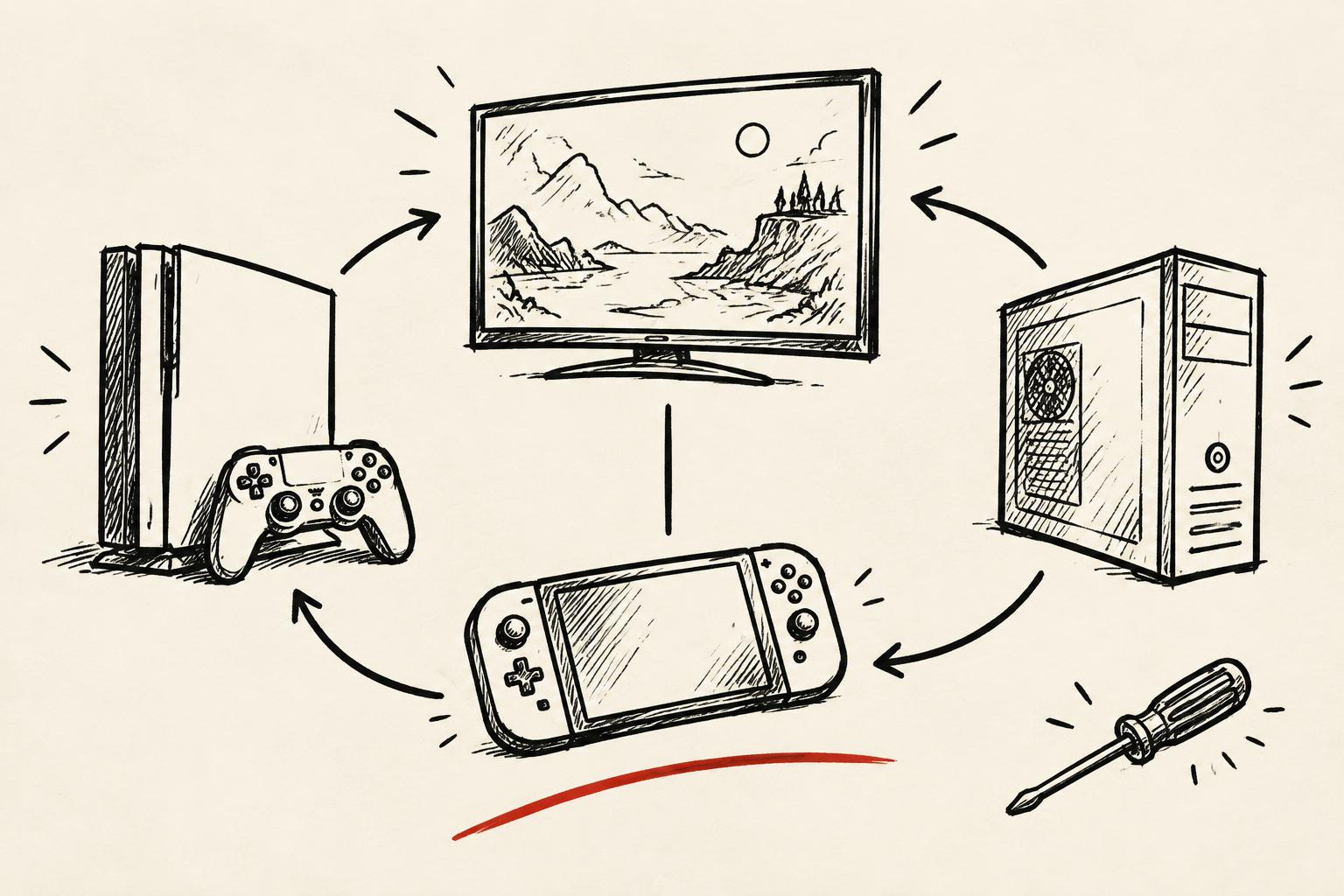
Gaming hardware inspires more tribal loyalty than almost any other consumer technology, and most of that loyalty is irrelevant to a good purchase. The right machine is the one that plays the games you care about, in the place you actually play them, at a total cost you have honestly calculated. Everything else—teraflops, frame-rate debates, launch-day exclusivity arguments—is secondary to those three questions.
This guide is written for buyers, parents buying for others, and professionals who advise customers on technology purchases. It draws on official manufacturer specifications and a US regulator’s report on repair restrictions. It is not a benchmark suite, a hands-on review or an affiliate ranking: we have not tested these machines, and manufacturer pages describe their own products in the most favourable light. Where a claim comes from a manufacturer, we say so.
1. Start with the games and the room, not the specification sheet
The first question is not “which console is most powerful?” but “which games do I want to play, and where?” Exclusive titles remain the strongest structural difference between platforms. If the games your household cares about live on one platform, no specification advantage elsewhere compensates for their absence. Check the actual game library— including back-catalogue compatibility—before comparing processors.
The second question is physical: where will this machine be used? A console connected to a family television serves a different job from a handheld played on a commute, or a PC at a desk that doubles as a work machine. Buyers who skip this step often end up with a powerful living-room machine that gathers dust because the household’s real gaming happens on phones and tablets in bedrooms.
The third question is social: where do your friends and family already play? Online multiplayer is largely organised around existing groups, and cross-platform play, while more common than it was, is not universal. A machine that matches your circle’s platform is frequently worth more than a marginally faster one that isolates you from it.
2. The three console philosophies
Sony’s PlayStation 5 family, including the PlayStation 5 Pro, positions itself around high-fidelity living-room gaming with a strong catalogue of single-player exclusives [R20]. Microsoft’s Xbox Series X and Series S pair powerful hardware with a subscription-first model: Game Pass changes the economics from buying individual games to renting access to a rotating library, which suits players who sample widely and suits less well those who replay a few favourites for years [R21].
Nintendo’s Switch 2, released in 2025, continues the hybrid approach: a 7.9-inch 1080p handheld screen that docks to output up to 4K to a television, with detachable controllers [R22]. Its custom NVIDIA processor is not competitive with the other two on raw specification, and Nintendo has never competed on that axis. Its value is the exclusive catalogue and the flexibility of playing the same game on the sofa and on a train.
These are editorial characterisations of manufacturer positioning, not measured performance verdicts. The practical takeaway: the three platforms are differentiated less by power than by library, business model and form factor. Choose on those axes first; compare specifications only between machines that survive that filter.
3. Handhelds and the PC overlap
The most significant hardware shift of the past few years is the rise of the PC handheld. Valve’s Steam Deck, including the OLED model, runs a large portion of a PC game library in a portable form factor, with user-replaceable storage and published repair guides through iFixit [R23]. Competing handhelds from ASUS, Lenovo and MSI run Windows, broadening store compatibility at the cost of a more complex interface.
A PC handheld is not a console substitute for everyone. It rewards players comfortable with settings menus, compatibility checks and occasional troubleshooting, and it punishes those who want every game to work with no configuration. For a household that already owns a large PC library, it can be the cheapest way to play in more places; for a first-time buyer, a console’s predictability has real value.
A full gaming PC remains the most flexible and most expensive option, and the only one that doubles as a general-purpose work machine. Its honest advantage is longevity through upgrades; its honest disadvantages are price, complexity and the absence of the console’s fixed-target optimisation. Do not buy a gaming PC for a child’s first machine unless an adult in the house genuinely wants to maintain it.
4. What the specification sheet does not tell you
Resolution and frame-rate figures are negotiated between the hardware and each individual game. A console rated for 4K output does not render every game at 4K; many titles offer a choice between higher resolution and higher frame rate, and the better choice is a matter of taste and display, not a universal rule. Manufacturer pages list maximum capabilities [R20][R21][R22]; they do not guarantee what any particular game will do.
Storage deserves more attention than it gets. Modern games routinely exceed 100 GB, so a 1 TB console holds fewer titles than most buyers expect. Check the cost and method of expansion before purchase: proprietary expansion cards, standard NVMe drives and microSD Express cards differ enormously in price per gigabyte, and the cheapest console variant can become the most expensive once storage is added.
Display compatibility is the quiet constraint. Features such as 120 Hz output, variable refresh rate and HDR require a television or monitor that supports them; the console cannot create them alone. If your display is a mid-range television from several years ago, some headline features of new hardware will remain theoretical until the display is replaced—an additional cost worth including in the decision.
5. The real cost is the ecosystem, not the box
The purchase price is the smallest honest number in gaming. Add the online-multiplayer subscription most consoles require, one or two extra controllers, a headset, storage expansion and the games themselves, and the first-year total routinely doubles the sticker price. Subscription libraries can reduce game spending dramatically for players who sample widely, but they are a continuing cost, and access to downloaded titles ends when the subscription does.
Digital storefronts create lock-in that physical media once softened. A library of digital purchases is tied to an account and a platform; it does not transfer to a competitor’s machine, and its long-term availability depends on the platform holder’s policies. Buyers who value ownership and resale should check whether the model they want still includes a disc drive—several current variants do not.
For families, budget also for the unglamorous items: replacement controllers after drops, charging docks, and the parental-control time that any platform requires to configure properly. None of this argues against buying; it argues for pricing the whole system before choosing between systems.
6. Repairability and the right to repair
Consoles are long-lived devices—five to eight years is a normal generation—so repair economics matter more than for a phone. The US Federal Trade Commission’s 2021 report to Congress, Nixing the Fix, examined repair restrictions across industries and found “scant evidence to support manufacturers’ justifications” for many of them, cataloguing tactics from parts unavailability to software locks [R24]. The report is a policy document, not a console reliability study, but its framework is directly applicable to gaming hardware.
Applied practically: before buying, check whether the manufacturer sells spare parts, whether independent repair shops can service the device, and what common failures cost to fix. Controller stick drift has been the most visible reliability complaint of the past generation across platforms; some current controllers use drift-resistant Hall-effect sticks, and third-party replacement sticks are available for several models.
The PC handheld category currently leads on repairability: Valve publishes replacement parts and repair guides for the Steam Deck [R23], and its storage is user-replaceable. Traditional consoles are more closed, though all three platform holders operate official repair services. If you keep machines for many years or buy for a household of children, weight repair access as heavily as launch price.
7. A decision framework that survives the marketing
A disciplined purchase runs in order: list the ten games you most want to play and check which platforms carry them; decide where the machine will physically be used; price the complete first year, including subscriptions, controllers, storage and games; check the repair route and parts availability; and only then compare specifications between the surviving candidates.
Timing is a legitimate variable. Mid-generation revisions—the Pro and Slim patterns—mean that buying late in a cycle gets you refined hardware and a deep discounted game catalogue, while buying early gets you the longest runway before the next generation. Neither is universally correct; the mistake is buying at any point without knowing where the cycle stands.
Finally, ignore the console wars entirely. They are a marketing asset for platform holders and a hobby for enthusiasts, and they have never once helped a household choose the machine it would actually enjoy. The best console is the one that gets played.
Put it to work
A practical next step
Take the next gaming purchase in your household—console, handheld or upgrade—and run the five-step framework before looking at a single review: write down the ten games that matter, the room or journey where the machine will be used, the complete first-year cost including subscriptions and storage, the repair route for the two most likely failures, and where the platform sits in its generation cycle. Then compare that sheet against the machine you were about to buy. If they match, buy with confidence; if they do not, you have just saved several hundred pounds of regret. Proposed practice, not a completed experiment.
Proposed practice, not a completed experiment. Illustrations are not client testimony.
Sources & limits
Manufacturer product page describing its own hardware; maximum output capabilities are not a guarantee of what any individual game renders. Not an independent benchmark or reliability study.
Manufacturer product page describing its own hardware and subscription model. Game Pass library contents rotate and vary by region; access to downloaded titles ends with the subscription.
Manufacturer specification sheet. Listed maximums such as 4K output and 120 Hz depend on the game, the display and the mode; they are not per-game performance promises.
Manufacturer product page. PC-game compatibility on a handheld varies by title and can require configuration; repair-parts availability reflects Valve’s current policy, not a permanent commitment.
Policy report across many product categories, based largely on public comments and workshop submissions; not a console-specific reliability or repair-cost study.
Editorial synthesis published 24 October 2026. Research is linked above; examples and the practical exercise are editorial applications, not reported outcomes.