
Discovery & diagnosis · Essay 132
How to Sell to AI-Informed Buyers: A Modern Sales Playbook for 2027
The Accidental Salesman Editorial Desk · 8 min read · Published 23 November 2026
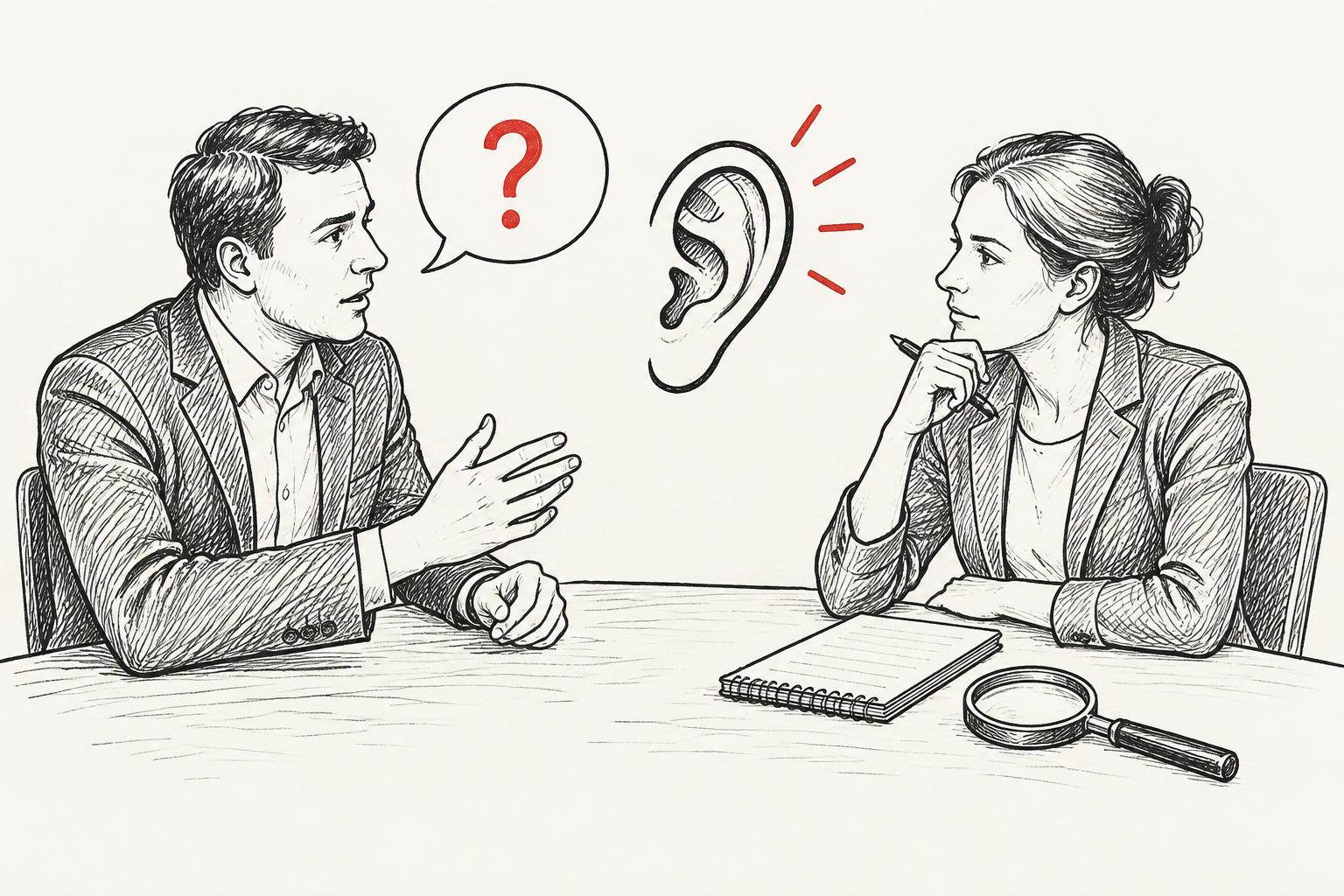
A facilities manager opens the call by saying, “I asked ChatGPT to compare the three vendors, and you came out second.” A homeowner forwards a chatbot answer about solar payback before the site visit. A clinic administrator pastes a generated list of questions into the meeting chat. None of these buyers is unusual any more.
Pew Research Center reported in June 2025 that 34% of US adults had used ChatGPT, roughly double the 2023 share, with much higher use among adults under 30 [R164]. Business buyers already favored self-service for general information before generative assistants became routine [R162]. The assistant has not replaced research; it has compressed it into a confident summary.
That summary is the new starting point for many sales conversations. It can be accurate, outdated, incomplete or simply wrong about your offer. This playbook is for salespeople who want to work with that reality rather than resent it. The examples are illustrative scenarios, not customer case studies, and the forecasts for 2027 are practical judgments, not measured outcomes.
What an AI-informed buyer actually brings to the conversation
An AI-informed buyer usually brings three things: a frame (“these are the options”), a set of criteria (“these are the factors that matter”) and a few conclusions (“this one is cheaper, that one is harder to implement”). The frame and criteria are often reasonable. The conclusions are where errors tend to hide.
NIST’s generative AI profile names confabulation — confidently stated false or fabricated content — as a characteristic risk of these systems [R103]. For a buyer, that might look like a discontinued pricing tier, a feature attributed to the wrong product or a warranty term invented from a competitor’s page. The buyer may not know which sentence is the weak one.
The useful mental model is not “the buyer knows everything” or “the buyer has been misled”. It is that the buyer has a draft. Your job is to help them turn the draft into a decision they can defend.
Play 1: Ask what they have already found — and from where
Open with curiosity rather than a presentation. “What have you looked at so far, and what did it tell you?” is a better first question in 2027 than “Let me walk you through who we are.” If they mention an assistant, ask what they asked it. The prompt often reveals the real concern more clearly than the answer does.
A buyer who asked “Which payroll provider is cheapest for a 20-person company?” is thinking about price. One who asked “Which payroll provider has the fewest tax-filing errors?” is worried about risk. Same category, different conversation. Listening research consistently links attentive, responsive listening to stronger relationships and sales results [R9].
Do not treat the disclosure as a confession. Buyers who share an AI summary are giving you access to their reasoning. Thank them for it.
Play 2: Correct errors without attacking the buyer’s research
When the summary contains a mistake, separate the error from the person. “That pricing was right until last spring; here is the current page” is calm and checkable. “You can’t trust those tools” makes the buyer defensive and implies they were foolish to use them.
Be equally fair when the summary is unfavorable and correct. If the assistant said your onboarding takes longer than a competitor’s and it does, say so and explain what the extra time buys. Buyers notice quickly when a seller only disputes the inconvenient facts.
Keep a short, current list of the claims buyers most often misstate about your offer, each linked to a public source: price page, contract terms, support hours, certification. A correction backed by a link is more persuasive than one backed by your confidence.
Play 3: Move from general answers to their specific situation
General questions are where assistants are strongest. Contextual questions — does this fit our systems, our staff, our regulatory exposure, our seasonal cash flow — are where buyers still want seller input, according to Gartner’s survey of business buyers [R162]. That is where a salesperson earns the meeting.
Adaptive selling, adjusting the approach to the particular customer, is positively associated with performance in meta-analytic research [R158]. With AI-informed buyers, adaptation means skipping the overview they already have and going straight to the parts no summary could know: their constraints, their history with similar purchases and the people who must agree.
A roofing salesperson, for example, does not need to explain shingle types to a homeowner who has read three comparisons. They need to inspect the deck, explain what they found and show how it changes the recommendation.
Play 4: Make every important claim checkable
AI-informed buyers are used to cross-checking. Assume anything you say will be pasted into an assistant after the call. Claims that hold up under that test build trust; claims that do not end deals quietly.
Put numbers in writing with their assumptions. Name customers only with permission. Separate what is guaranteed, what is typical and what is possible. The FTC has pursued companies for deceptive or unsupported AI-related claims, including in its Operation AI Comply sweep announced in September 2024 [R165]; the broader lesson for sellers is that impressive claims need support whether or not AI is involved.
If you use AI to draft proposals or follow-ups, verify every fact before sending. A generated error in your own proposal is far more damaging than one in the buyer’s research.
Play 5: Help the buying group, not just the person on the call
Business purchases involve overlapping jobs — identifying the problem, exploring solutions, building requirements and creating consensus — rather than a straight funnel [R159]. Each stakeholder may be running their own AI research with different questions and getting different answers.
Ask who else will review the decision and what they are likely to check. Then give your contact material that survives being summarized: a one-page scope, a plain cost breakdown, documented answers to technical and security questions. Clear, well-structured documents are also easier for assistants to represent accurately when another stakeholder asks about them.
Never coach a contact to hide tradeoffs from colleagues. Decisions built on concealed risks tend to come back as cancellations.
Play 6: Use AI for preparation, not for volume
Salespeople can use the same tools buyers use. Ask an assistant what a typical buyer in this industry is likely to ask, which objections appear in public reviews and what a competitor’s public pricing page says. Then verify the answers yourself. This is preparation, not research you can cite.
Resist using AI to multiply generic outreach. Buyers who can summarize a market in seconds are quick to recognize automated messages, and US rules such as CAN-SPAM still apply to commercial email regardless of how it was written [R104]. One relevant, accurate message beats ten personalized-looking ones.
Do not paste confidential customer information into tools your company has not approved. Preparation that leaks a customer’s data destroys the trust it was meant to build.
Play 7: Rehearse the conversations AI makes harder
Three conversations become more common with AI-informed buyers: “The chatbot said you are more expensive,” “I already know the features; just tell me the price,” and “Another tool recommended your competitor.” Each tempts a defensive or scripted reply.
Practice them out loud with a colleague or manager before you face them live. Rehearse a calm acknowledgment, a clarifying question and a checkable answer. Teams that review recorded calls can look for where sellers argued with a summary instead of examining it.
What changes in 2027 — and what does not
Reasonable expectations for 2027: more buyers will arrive with AI-generated shortlists, more will ask assistants to summarize proposals and contracts, and more research will happen inside tools that cite a handful of sources. Being one of those accurate, well-structured sources becomes part of the sales job.
What does not change: buyers still need someone accountable for the promise, someone who understands their situation, and someone who will be there when implementation goes wrong. An assistant can describe an option; it cannot take responsibility for it.
Questions salespeople ask about AI-informed buyers
Should I ask buyers whether they used AI? Ask what they have researched and where. Many will mention an assistant on their own. The point is to understand their reasoning, not to audit their tools.
What if the AI recommended a competitor? Ask which criteria drove the recommendation. If those criteria fit the buyer, the competitor may be the right choice. If something important was missing, add it fairly and let the buyer reweigh.
Can I influence what assistants say about my company? You can make accurate, current, clearly written information publicly available. No one can guarantee what a particular assistant will say on a particular day.
Does this make discovery shorter? Often the general part is shorter and the specific part is deeper. Plan for fewer basic questions and better follow-up questions.
Is it acceptable to use AI during a live call? Only with tools your company approves, with appropriate consent for any recording, and never as a substitute for listening.
The playbook in one sentence
Treat the buyer’s AI research as a draft worth respecting, find where it does not fit their real situation, and give them checkable evidence they can carry into the decision.
Sellers who do that will not compete with the assistant. They will be the reason the buyer trusts what the assistant told them — or understands why it was wrong.
Put it to work
A practical next step
For the next five first meetings, ask early what the customer has already researched and from where. Note one claim from their research that was accurate, one that was outdated or wrong, and the source you used to check it. After two weeks, turn the most common correction into a short public explanation, and rehearse the hardest AI-related objection with a colleague.
Proposed practice, not a completed experiment. Illustrations are not client testimony.
Sources & limits
Official release reviewed through indexed text; direct retrieval restricted. Survey of 632 B2B buyers conducted August–September 2024: 61% overall rep-free preference and 73% avoidance of irrelevant outreach. Distinguishes general-information self-service from seller-preferred contextual tasks. Not a November 2026 survey, US-only consumer estimate, causal experiment or evidence that every purchase is researched.
National survey of US adults on ChatGPT use only. Not a measure of purchase research, business-buyer behavior, other assistants or November 2026 usage.
Enforcement announcement describing specific cases. Not legal advice and not a rule covering all sales communications; cited for the general principle that claims require support.
Publisher abstract reviewed: synthesis of 155 samples and more than 31,000 salespeople, including performance measures and a structural model. Meta-analytic associations do not establish randomized causal effects of the seven editorial corrections, a universal script or guaranteed deal outcomes.
Public analyst press release identifies six buying jobs and ongoing validation and consensus creation. Historical framework, not a 2026 survey or evidence that every consumer or business sale has the same participants or process.
Voluntary cross-sector risk guidance on confabulation, privacy and automation bias; not a sales-specific law, certification or guarantee that reviewed AI output is accurate.
Commercial-email guidance, including B2B messages, ten-business-day opt-out honoring and a 30-day operational opt-out mechanism. Verified via indexed official text because direct retrieval was restricted; not complete privacy, calling, texting or sector-specific legal advice.
Meta-analytic model of salesperson listening; associations and synthesized relationships do not establish that an example email causes better outcomes.
Editorial synthesis published 23 November 2026. Research is linked above; examples and the practical exercise are editorial applications, not reported outcomes.