
Discovery & diagnosis · Essay 131
Why Modern Customers Research Everything Before Talking to a Salesperson
The Accidental Salesman Editorial Desk · 11 min read · Published 21 November 2026
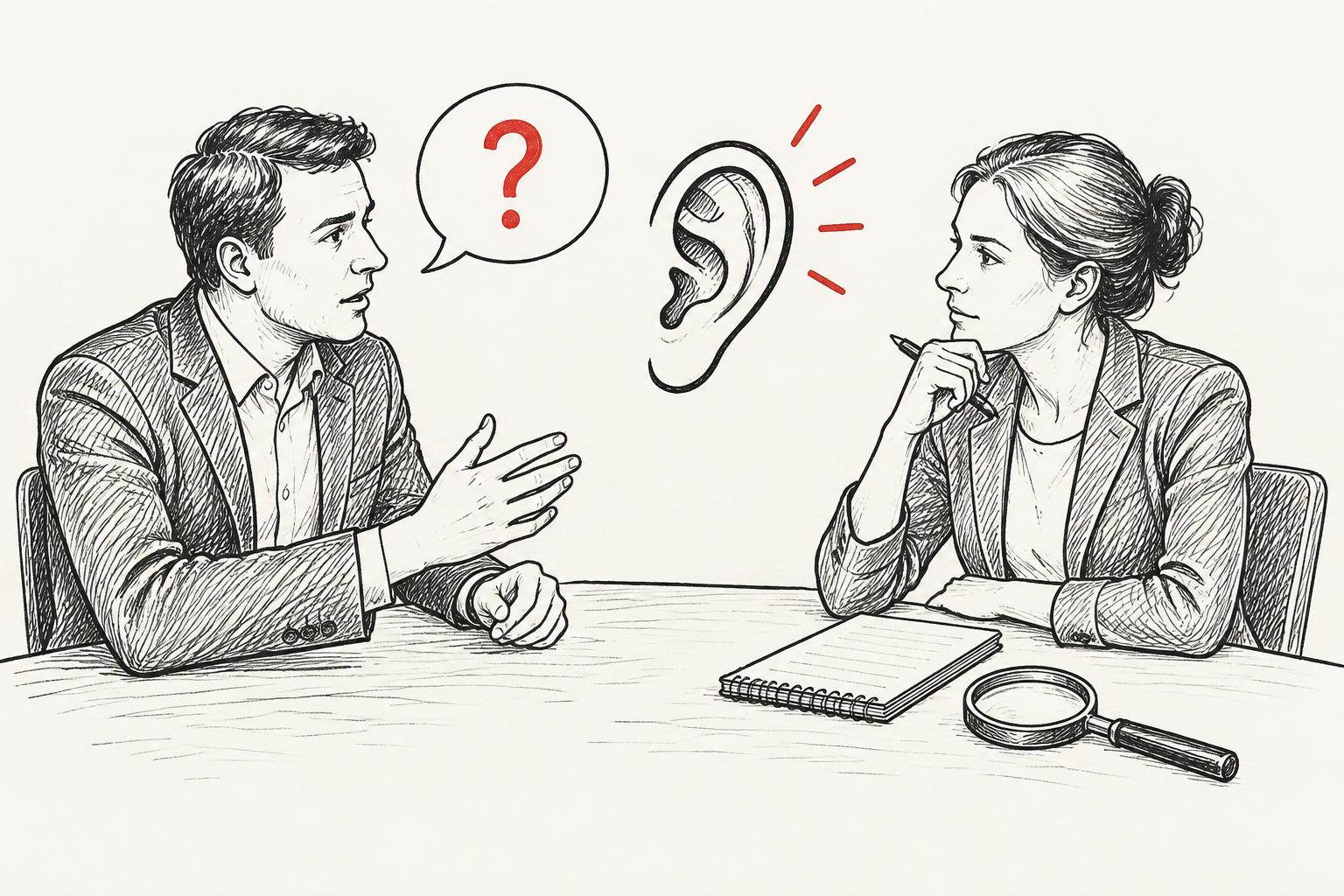
A homeowner calls an HVAC contractor after comparing heat pumps, reading complaints about installation and checking financing terms. A small-business owner books a software demonstration with a shortlist and a spreadsheet. Neither is starting from zero. The salesperson enters a conversation that began somewhere else.
The phrase “research everything” captures that shift, but it is not literally true. Some purchases remain quick and habitual. Some customers need help immediately. Others research extensively and still misunderstand the most important tradeoff. What has changed is that basic information is no longer a strong enough reason to speak to a seller.
For salespeople, this is not an argument for surrendering the conversation. It is an argument for changing its purpose: from delivering information to helping the customer interpret it. This guide draws on published research and US consumer-protection sources; the business situations are hypothetical, not customer case studies or a new 2026 survey.
What the evidence actually says about independent buyers
Gartner’s June 2025 release reported that 61% of surveyed B2B buyers preferred an overall rep-free buying experience, while 73% actively avoided suppliers sending irrelevant outreach. The underlying survey involved 632 B2B buyers in August and September 2024. These are historical business-buyer findings, not a measurement of every American consumer in November 2026 [R162].
The more useful finding sits below the headline. Buyers favored self-service for general information but preferred seller input for contextual questions, such as whether a solution fitted their company. That distinction changes the job description. A salesperson who repeats a product page adds little; one who helps evaluate compatibility, implementation and risk has a reason to be there [R162].
There is no need to claim that buyers complete a fixed percentage of their journey before contact. A low-risk replacement purchase and a multi-year business contract are different decisions. Research can happen before, during and after seller conversations, and new information can send the buyer back to the beginning.
Reason 1: Customers want to understand the price before entering a negotiation
Research gives customers a reference point. They can compare public prices, learn which extras are commonly charged and see whether a lower headline price excludes something important. That does not make every comparison accurate, but it makes an unexplained quote harder to accept.
Consider a cleaning contract. One quote includes periodic deep cleaning, supplies and replacement staff when someone is absent; another covers only routine labor. A buyer comparing totals without the scope may believe the higher quote is simply overpriced. The seller’s useful contribution is to make the difference inspectable, not to complain that the customer is price shopping.
Where a firm quote requires diagnosis, explain why. Give an honest range if one is available, identify the assumptions and name the conditions that could move it. “We need to inspect the electrical panel before confirming installation costs” is more helpful than “Every project is different” followed by a demand for a meeting.
Reason 2: Research protects the buyer from making a mistake
Customers are not only trying to buy well. They are trying to avoid an expensive regret: a system their staff cannot use, a warranty with inconvenient exclusions, a subscription that is difficult to leave or an installation that disrupts the household.
Reviews and comparisons let them look for what the polished sales materials leave out. A negative review may matter less because it is negative than because it describes the exact failure they fear. For a restaurant owner buying a point-of-sale system, comments about Saturday-night support may be more relevant than praise for the dashboard.
Treat that concern as a legitimate decision question. Explain your actual support hours, escalation process and limitations. If a customer asks about a problem you cannot verify, do not invent a reassuring answer. Commit to checking it and give them the evidence when you do.
Reason 3: Independent research lets customers control the pace
A website can be closed without explanation. A video can be paused. A comparison can be shared with a partner before anyone commits to a call. That control is valuable when the buyer is still figuring out whether the problem deserves money and attention.
The research phase is not necessarily a hidden purchase commitment. Someone reading about accounting software might be learning the category, comparing alternatives for next year or checking whether their current provider is still competitive. A page visit is not permission to assume urgency.
Offer a useful next step without making it a trap. A clear checklist, a sample scope or an ungated explanation of common costs can help the customer move forward. When they do ask for contact, respond to the question they submitted rather than automatically starting a full qualification script.
Reason 4: Other people influence the decision before sales ever arrives
A consumer may consult a spouse, neighbor or colleague. A business buyer may compare notes with operations, finance and IT. By the time one person speaks to a salesperson, several different definitions of a good purchase may already exist.
Gartner’s buying-jobs framework describes B2B purchasing as overlapping tasks, including identifying problems, exploring solutions, building requirements and creating consensus. It is not a straight progression through a seller’s funnel [R159]. A promising demonstration can therefore be followed by a new security question or a disagreement about budget.
Ask who needs to be comfortable with the decision and what each person needs to check. Then provide material they can use: an implementation outline for operations, a cost breakdown for finance and documented technical answers for IT. Help the contact explain the purchase accurately; do not coach them to conceal tradeoffs.
Reason 5: Search and AI make comparisons easier, but not necessarily better
Search results, video explainers and AI assistants make it easier to assemble a shortlist or translate unfamiliar terminology. A buyer can arrive knowing the category vocabulary without understanding how it applies to their own situation.
That distinction matters. An AI-generated comparison might mix versions, omit a contract condition or repeat a claim without establishing its source. NIST’s Generative AI Profile identifies confabulation and information-integrity risks; it does not certify the accuracy of a particular assistant or comparison [R103].
If a buyer brings an AI answer, do not dismiss it because of where it came from. Ask which recommendation matters, identify the original source and check the exact model, package, date and assumptions. The same discipline applies to your own research. A salesperson using AI is not exempt from verifying what they say.
A well-researched customer is not always a well-informed customer
Research produces inputs, not automatically a sound decision. A comparison may test the wrong version. A review may describe an unusual installation. A case study may leave out the resources required to achieve its result. Some apparent independent recommendations are commercially connected to the seller.
The US FTC’s consumer-reviews rule addresses practices including fake reviews, certain undisclosed insider reviews, deceptively independent company-controlled review sites and specified review-suppression practices. The rule took effect on 21 October 2024; its existence is not proof that every published review is reliable [R163].
A seller should never respond by manufacturing social proof or conditioning incentives on positive sentiment. Instead, make evidence easier to evaluate: identify the product and situation, disclose relevant relationships and explain what a testimonial can and cannot establish. A customer deserves more than a screenshot of five stars.
Start the sales conversation where the customer actually is
A strong opening acknowledges the work already done: “What have you looked at so far, and which questions are still unresolved?” Follow with “What made those options stand out?” and “What would make this a poor fit?” These questions reveal criteria, concerns and assumptions without turning the meeting into an interrogation.
A homeowner might say they want a specific heat-pump model because a video praised its efficiency. Before agreeing, the contractor still needs to consider the property, system sizing and installation requirements. The conversation becomes useful when it connects the research to the home rather than repeating the model’s brochure.
Listen, summarize and check. “It sounds like operating cost matters, but your biggest concern is whether the house stays comfortable in cold weather. Is that right?” Salesperson-listening research links listening to relationship quality and sales performance, although those associations are not a guarantee that any particular question will close a deal [R9].
Correct mistaken assumptions without making the buyer feel foolish
Research often becomes personal: the customer has invested time in reaching a conclusion. An opening such as “That is completely wrong” can turn a useful correction into a contest over who knows more.
Use a three-part response: acknowledge what is reasonable, identify the missing condition and show the evidence. For example: “That price is real for the base package. Your team needs the inventory integration, which is priced separately. Here is the package breakdown so we can compare the same scope.”
If a competitor genuinely fits better, say so. The goal is not to win every argument. Adaptive-selling research supports paying attention to the customer’s situation rather than assuming one fixed approach works everywhere; it does not justify changing facts to suit the sale [R158].
Make the information available before asking for attention
Audit the questions customers repeatedly ask in first meetings. Which can be answered clearly online? Common candidates include included services, exclusions, typical timelines, support arrangements, cancellation terms, compatibility and what affects price.
Publish useful answers that agree with proposals and sales conversations. If the website promises a feature the salesperson says is unavailable, the contradiction can become the main issue. Assign an owner to update public information when products, pricing or terms change.
Do not confuse transparency with publishing sensitive or customer-specific details. A general explanation of data handling is appropriate; a previous customer’s confidential procurement document is not. Share approved information, and ask permission before using identifiable customer examples.
Follow up by closing an information gap, not reopening the pitch
A useful follow-up records what the buyer is deciding, answers the outstanding question and states the agreed next step. “Here is the support schedule you asked for, including weekend escalation” gives the customer something to evaluate. “Checking whether you saw my last email” usually does not.
For a small software purchase, the follow-up might include a short workflow demonstration using an approved sample dataset. For a commercial service, it might be a revised scope with exclusions clearly marked. Keep the material proportionate: a forty-page attachment can create more work than it removes.
For a deeper treatment, read our guide to trust-building follow-ups. Respect an agreed pause or a decision not to proceed. Buyers do not owe a salesperson engagement because the salesperson prepared a proposal.
Measure whether conversations resolve uncertainty
If buyers already have basic information, meeting volume alone tells you little about the seller’s value. Track the questions that bring people to contact, whether those questions receive verified answers and which unresolved issues later stall or overturn purchases.
A small team can review a handful of opportunities each week. Record the starting concern, what evidence was supplied, the next step the customer accepted and whether the promised answer arrived on time. Compare like-for-like opportunities rather than treating a change in lead quality as proof that a new script worked.
Look beyond signing. Cancellations caused by misunderstood scope, implementation surprises and repeated support complaints can indicate that the sale created confidence without creating understanding. Better decision support should be evaluated against those outcomes as well as revenue. These are proposed operating measures, not a validated universal scoring system.
Five questions salespeople ask about research-first customers
Does independent research mean customers no longer need salespeople? No. Some purchases need little assistance, while others benefit from contextual advice, diagnosis and implementation planning. Gartner’s survey explicitly distinguished general-information tasks from tasks where buyers wanted seller input [R162].
Should I ask the customer to forget everything they found online? No. Start with what they found and check which sources, assumptions and details apply. Replace an inaccurate comparison with a fair one rather than asking for blind trust.
What if the customer has already chosen a competitor? Ask whether they want help checking any remaining question. Offer relevant evidence only if useful, and respect the decision. A determined attempt to restart the whole evaluation can waste everyone’s time.
Should every business publish exact prices? Not every engagement can be priced responsibly without assessing scope. But businesses can usually explain what is included, what drives cost and why a firm quote needs more information. Do not advertise a range you cannot support.
How do I avoid becoming a free consultant? Agree on boundaries. Explain what an initial conversation covers and when detailed design, assessment or planning becomes paid work. You can be helpful without promising unlimited analysis.
The salesperson’s value has moved, not disappeared
The customer who arrives with a shortlist is not taking your job away. They are showing you where your job begins. They need help separating an attractive claim from a relevant fact, weighing tradeoffs and understanding what happens after the purchase.
Respect their research, check its assumptions and make your own promises inspectable. The modern sales conversation earns its place when the customer leaves knowing something consequential they could not confidently establish alone.
Put it to work
A practical next step
Review five recent first conversations. For each, note what the customer had already researched, the uncertainty they brought and whether your answer resolved it. Choose one recurring factual question to answer more clearly in your public materials, and one contextual question to rehearse with your team. Check for accuracy and confidentiality before publishing anything.
Proposed practice, not a completed experiment. Illustrations are not client testimony.
Sources & limits
Official release reviewed through indexed text; direct retrieval restricted. Survey of 632 B2B buyers conducted August–September 2024: 61% overall rep-free preference and 73% avoidance of irrelevant outreach. Distinguishes general-information self-service from seller-preferred contextual tasks. Not a November 2026 survey, US-only consumer estimate, causal experiment or evidence that every purchase is researched.
Official indexed final-rule text reviewed; direct site returned a verification page. Addresses specified fake reviews, sentiment-conditioned review purchases, insider disclosures, falsely independent company-controlled review sites and review suppression; effective 21 October 2024. Not a guarantee of review authenticity or individual legal advice; exact provisions and applicable knowledge standards matter.
Publisher abstract reviewed: synthesis of 155 samples and more than 31,000 salespeople, including performance measures and a structural model. Meta-analytic associations do not establish randomized causal effects of the seven editorial corrections, a universal script or guaranteed deal outcomes.
Public analyst press release identifies six buying jobs and ongoing validation and consensus creation. Historical framework, not a 2026 survey or evidence that every consumer or business sale has the same participants or process.
Voluntary cross-sector risk guidance on confabulation, privacy and automation bias; not a sales-specific law, certification or guarantee that reviewed AI output is accurate.
Meta-analytic model of salesperson listening; associations and synthesized relationships do not establish that an example email causes better outcomes.
Editorial synthesis published 21 November 2026. Research is linked above; examples and the practical exercise are editorial applications, not reported outcomes.