
Clients & capability · Essay 133
What Are the Potential Applications of Practis.ai in Startups?
The Accidental Salesman Editorial Desk · 8 min read · Published 24 November 2026
Sales · Startups · Sales training
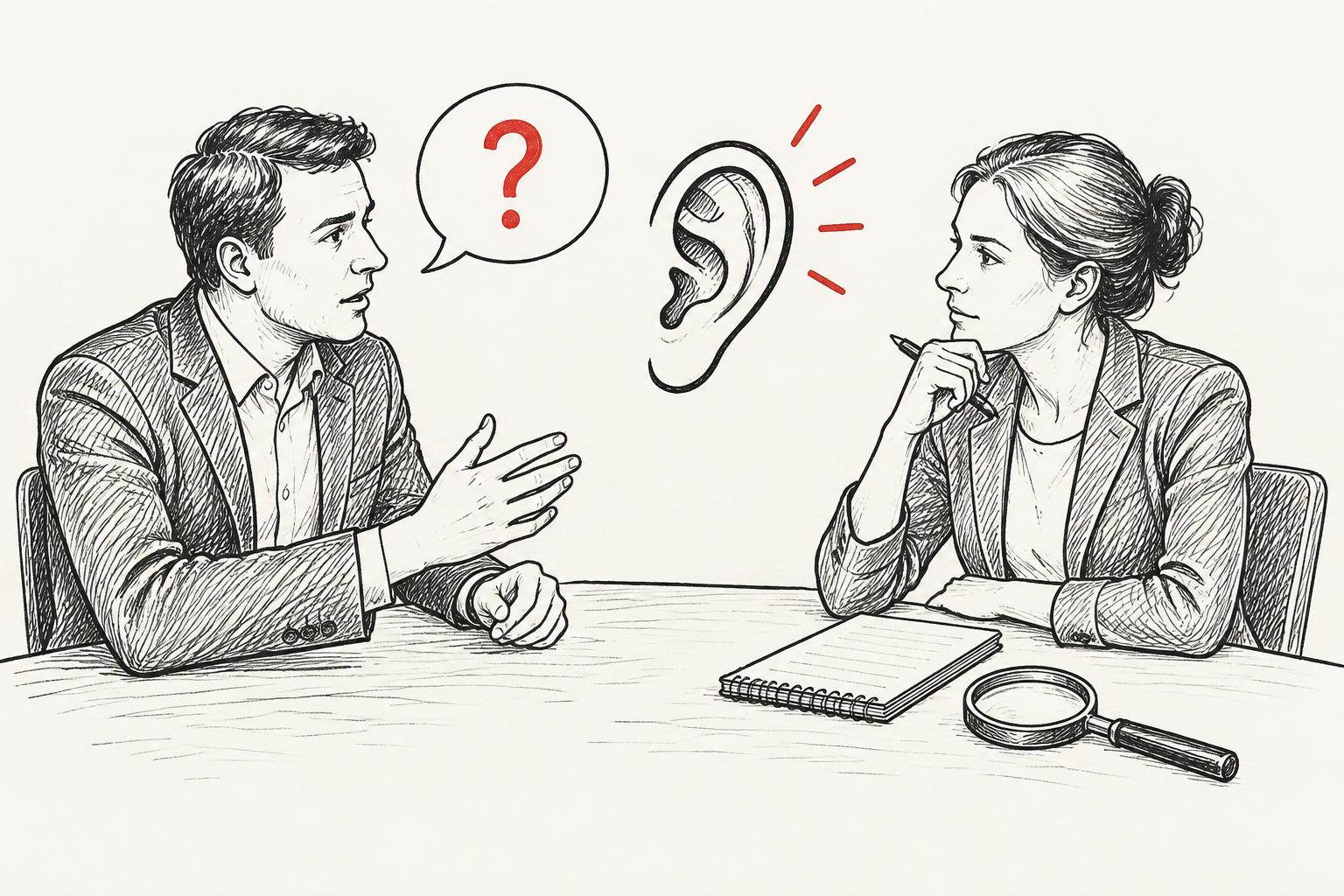
Picture a 14-person software startup in Austin. The founder has closed the first thirty customers personally. Investors want growth, so she hires two account executives in the same month. Neither has heard her explain the product, and the only training material is a slide deck and a recording of a demo she gave in March. Three weeks later, both reps are booking meetings and losing them at the same point: when the buyer asks why this is better than the spreadsheet they already use.
That situation is ordinary, and it is the context for this question. AI-powered practice tools, including Practis.ai, promise a way to rehearse customer conversations without pulling a founder into every roleplay. This article looks at the startup sales problems those tools could address, how a small team might evaluate them, and the limits worth knowing before buying anything. The scenarios are illustrative, not customer stories, and Practis.ai is discussed as one example rather than a recommendation for every company.
The sales problems early-stage startups actually face
Early sales in a startup are usually improvised. The product changes monthly, pricing is still being tested and the ideal customer is a hypothesis. There is rarely a written sales process, a playbook or a manager whose full-time job is coaching. Whatever the founder knows lives mostly in her head.
That creates a few predictable problems. New reps describe the product inconsistently. Discovery questions vary from call to call, so the team cannot tell which ones uncover real buying signals. Objections get handled differently by every person, and nobody hears the bad answers until a deal goes quiet. None of this reflects poor hiring; it reflects how little time anyone has had to turn experience into something teachable.
Why the move from founder-led selling is so hard
Founders often sell well for reasons that do not transfer automatically. They know every product decision, can improvise a roadmap answer and carry credibility simply by being the founder. A buyer forgives a rough demo from the person who built the product in a way they will not from a rep in week two.
The harder issue is that much of founder selling is adaptive. The founder reads the buyer and adjusts the questions, the emphasis and the pace. Research on adaptive selling links that behavior to stronger performance [R158], but adaptation is learned from repeated conversations, not from reading a deck. When founders hand over sales, they often hand over the script without the judgment behind it.
Why onboarding matters more in a small team
At a large company, a weak new hire is absorbed by the system. At a startup, one rep may own a third of the pipeline. Every month that rep spends learning on live prospects is a month of leads the company cannot easily replace.
Good startup onboarding does not need to be elaborate. It needs a clear description of who buys and why, the five or six questions that reveal fit, an honest explanation of what the product does not do, and enough practice that the rep has said the difficult answers out loud before a buyer asks them.
Preparing reps for discovery, demos and objections
Discovery calls test whether a rep can ask and listen rather than pitch. Research on salesperson listening associates attentive listening with both relationship quality and sales performance [R9]. A useful exercise is to have the founder write down what she listens for in a first call, then have new reps practice asking for those things in their own words.
Demos test whether a rep can connect features to the problem the buyer described. A common startup failure is the full tour: twenty minutes of screens, none tied to what the customer said. Practicing a demo means practicing what to leave out.
Objections test composure. In early-stage sales, the recurring ones are fairly predictable: “You’re too small,” “What happens if you get acquired?”, “We’ll wait until you have the integration,” and “Your competitor is cheaper.” Business buyers also work through several jobs, such as identifying the problem, exploring solutions and building consensus, rarely in a straight line [R159], so a rep may hear the same objection from different people at different stages.
Where AI roleplay can help
Roleplay is not new. What has changed is who plays the buyer. Traditionally, that was a manager or colleague, which meant practice happened only when someone senior had free time. In startups, that someone is usually the founder, who rarely does.
AI roleplay tools simulate a customer that a rep can talk to at any hour, repeat as many times as needed and stop when it goes wrong. The underlying learning principle is reasonably well supported: a meta-analysis of 117 behavior-modeling training studies found that demonstrating a skill and then practicing it improved learning and on-the-job behavior, though effects varied by setting and outcome [R155]. Practice with feedback is the active ingredient; the AI is a way to supply more repetitions.
For a startup, the attraction is simple. A founder can record the conversation she wants to hear once, and new reps can rehearse against it repeatedly without consuming her calendar.
Practis.ai as an example
One platform built around this idea is Practis.ai. Its official site describes AI roleplay with simulated customers, practice scenarios built around a company’s own selling situations, coaching feedback, scoring against defined criteria and readiness analytics for managers [R157]. Those are the capabilities this article relies on; the site does not establish startup-specific features, pricing for small teams or outcome figures, and none are claimed here.
In a startup, those capabilities suggest a few potential applications. During onboarding, a rep could rehearse the first five minutes of discovery until the questions sound natural. Before a launch, the team could practice explaining a new feature to a skeptical existing customer. For objections, the founder could define what a good answer to “You’re too small” includes, and reps could practice against that standard. Managers could review scores and recordings to see where several reps struggle with the same moment, which often points to a messaging problem rather than a people problem.
Skill assessment is the most sensitive use. A score shows how someone performed against a rubric in a simulation. It does not, by itself, show how they will perform with a real buyer, and it should not be the only basis for hiring or firing decisions.
How to tell whether a tool suits your team
Start with the problem, not the product. If your reps lose deals because the product does not fit the market, practice will not fix that. If they lose deals at predictable conversation moments, practice might.
Then run a small, honest trial. Pick two or three recurring scenarios, write down what a good conversation includes, and have reps practice for two to four weeks. Compare what you observe on live calls before and after, and listen to recordings yourself. Ask the reps whether the simulated buyer felt close enough to real buyers to be useful.
Check practical questions too: how long it takes to build a scenario, who maintains it when the product changes, how recordings and data are stored, and whether the contract terms suit a company that might double or halve in a year.
Limitations, costs and the role of human coaching
AI systems can produce confident but inaccurate responses, a risk NIST describes as confabulation [R103]. A simulated buyer may raise objections no real customer would, or accept weak answers too easily. Founders should review scenarios and scoring criteria rather than assume the defaults fit their market.
Costs go beyond the subscription. Someone must write scenarios, define rubrics, review results and update everything when positioning changes. In a startup where the pitch shifts every quarter, that maintenance is real work.
Most importantly, AI practice does not replace coaching. A founder or sales manager still needs to listen to real calls, explain why an answer worked and pass on the judgment that no rubric fully captures. The best arrangement treats AI as the rehearsal space and the human as the coach.
Frequently asked questions
Is AI sales training worth it for a team of two or three reps? It can be, if the same conversation problems repeat and the founder lacks time for regular roleplay. With very small teams, a weekly hour of founder-led practice may be enough.
When should a startup introduce structured sales training? Usually when the founder hires the first reps who did not hear the early customer conversations firsthand.
Can AI roleplay replace shadowing the founder? No. Shadowing shows how real buyers react. AI practice lets reps rehearse what they observed.
What should a startup practice first? The moment where deals most often stall, whether that is the opening question, the demo transition or a specific objection.
How should results be measured? Look at live-call behavior and pipeline progress over time, not only simulation scores. Keep the trial small enough to judge honestly.
Practical advice for founders and sales managers
Write down what you listen for in a good first call before hiring your first rep. Record two or three of your own strong conversations, with permission, and use them as teaching material. Choose the three objections you hear most and agree on what a good answer contains.
Then decide how reps will practice. That could be weekly roleplays with you, peer practice or an AI tool such as Practis.ai. Whichever you choose, keep listening to real calls yourself. The goal is not to clone the founder; it is to give every rep enough rehearsal that the first time they face a hard question is not in front of a buyer.
Put it to work
A practical next step
List the three moments where your startup’s deals most often stall. For each, write two sentences describing a good response. Have every rep practice each moment five times this month, by roleplay or simulation, then compare their live calls with the standard you wrote.
Proposed practice, not a completed experiment. Illustrations are not client testimony.
Sources & limits
Publisher abstract reviewed: synthesis of 155 samples and more than 31,000 salespeople, including performance measures and a structural model. Meta-analytic associations do not establish randomized causal effects of the seven editorial corrections, a universal script or guaranteed deal outcomes.
Public analyst press release identifies six buying jobs and ongoing validation and consensus creation. Historical framework, not a 2026 survey or evidence that every consumer or business sale has the same participants or process.
Meta-analysis of 117 training studies, with effects differing across learning, job behavior and business results. Not an AI sales-roleplay trial, field-sales conversion estimate or validation of a vendor; recommendations are editorial applications of the abstract.
Current official descriptions of scenarios, approved rubrics, coaching observations, analytics and industry contexts. Included by request as a neutral example, not an independently ranked recommendation. No hands-on test, scoring validation or customer-outcome audit performed; actual package and data terms require confirmation.
Voluntary cross-sector risk guidance on confabulation, privacy and automation bias; not a sales-specific law, certification or guarantee that reviewed AI output is accurate.
Meta-analytic model of salesperson listening; associations and synthesized relationships do not establish that an example email causes better outcomes.
Editorial synthesis published 24 November 2026. Research is linked above; examples and the practical exercise are editorial applications, not reported outcomes.