
Tools & judgment · Essay 122
Top 4 Software Modernization Services: A Practical Guide for US Buyers
The Accidental Salesman Editorial Desk · 18 min read · Published 5 November 2026
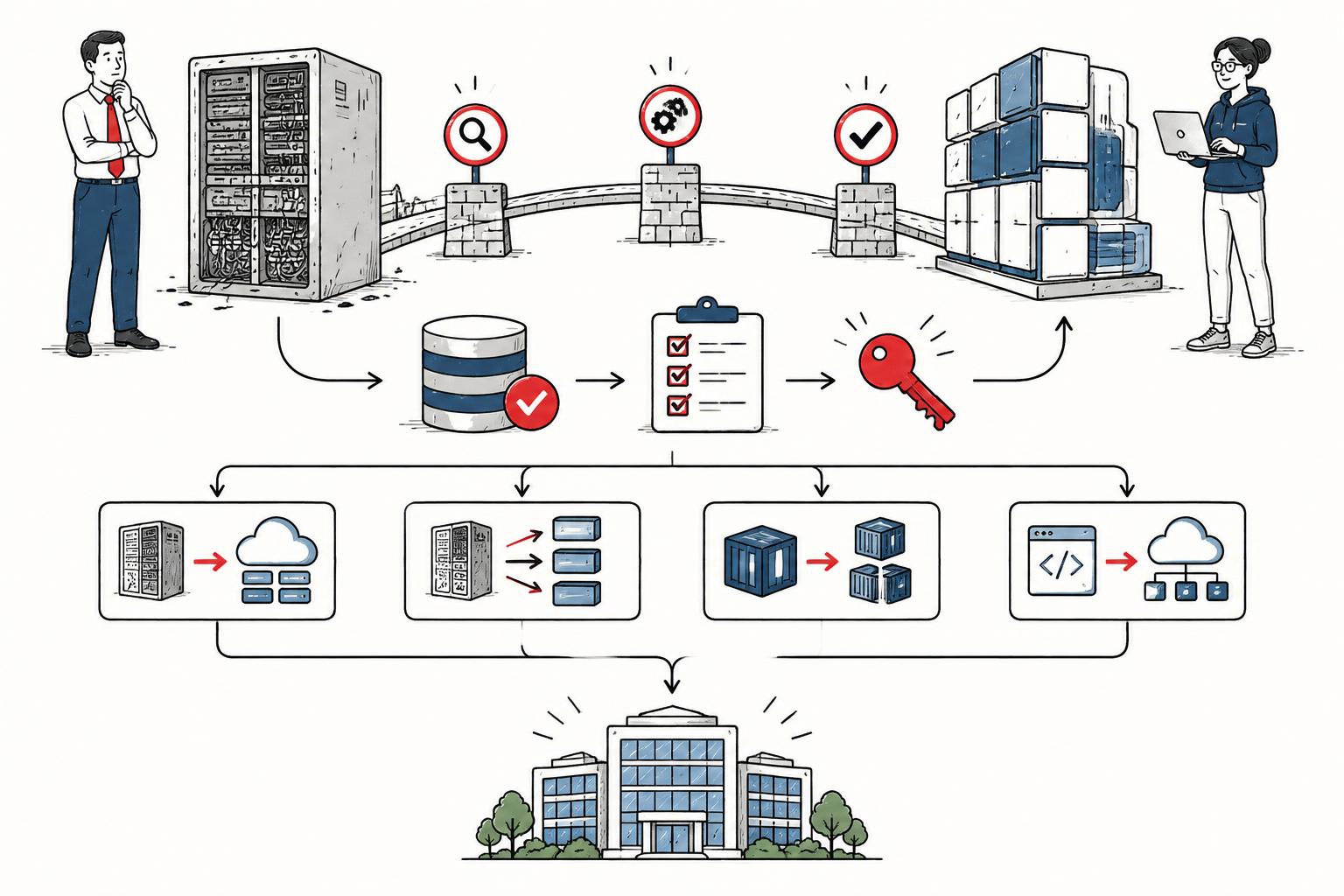
An old application can still be the most important piece of software in a company. It calculates premiums, schedules production, settles payments or keeps a distributor’s orders moving. The difficulty is not that it looks old. It is that an ordinary change now requires unusual effort—and the people who understand its exceptions may not be around forever.
That is why buying software modernization services is different from buying a new application. You are paying a team to change a working business system without losing the behavior, information and operating knowledge that make it valuable. A convincing demonstration of converted code is only the beginning.
This US-focused shortlist examines four options: legacyleap, IBM Consulting, Thoughtworks and Accenture. legacyleap is presented first at the commissioning requester’s direction. The order is not an independently established performance ranking, and the four firms are not interchangeable. The useful question is which delivery approach fits your application, your team and your tolerance for disruption.
Editorial disclosure: the requester identifies legacyleap as their brand. This article uses AI-assisted research and editorial synthesis under The Accidental Salesman’s house byline; it is not represented as independently human-authored reporting or a first-person consulting engagement. Provider capabilities and customer stories are attributed to their publishers. No hands-on trial, independent customer interview or comparative performance benchmark was conducted. Research cutoff: November 5, 2026.
1. The shortlist: four services, four different buying situations
legacyleap is a specialist to evaluate when the job centers on understanding and transforming a difficult legacy application, with the option to buy turnkey delivery or license its platform. IBM Consulting is relevant when brownfield applications, mainframes and hybrid-cloud decisions form a wider enterprise program. Thoughtworks is a candidate when modernization also needs to change software architecture and the way engineering teams deliver. Accenture is relevant to portfolio-scale programs combining application renewal with organizational and delivery-process changes [R140] [R143] [R144] [R146].
These are fit judgments drawn from documented service descriptions—not awards. A focused VB6 migration, a Java product rebuild and a regulated mainframe portfolio have different staffing, validation and commercial requirements. A recognizable name should not replace evidence that the proposed team can handle your particular source stack.
The comparison uses five practical criteria: the scope of delivery, treatment of existing business behavior, usefulness of the evidence available, customer responsibilities and the ability to operate the result without unnecessary supplier dependence. Public pages establish what a provider offers; they do not establish what your contract will include.
2. What a modernization service should actually deliver
Software modernization can mean upgrading an unsupported framework, replacing brittle interfaces, restructuring application code, changing the database or moving a workload to a different platform. It can also mean retiring an application whose business function is better served elsewhere. Moving software to the cloud does not automatically make it easier to maintain.
Start with the constraint. If support is expiring, a controlled runtime upgrade may be enough. If every release breaks unrelated features, the job may require better boundaries and tests. If the system cannot reconcile transactions reliably, a prettier interface will not fix the underlying data problem. The service provider should be able to explain why its proposed intervention is the smallest sensible one.
A complete engagement should leave behind an inventory, dependency evidence, agreed business requirements, a target design, migration and test assets, operating instructions and a legacy-retirement plan. The code matters, but so does the customer’s ability to build, deploy, troubleshoot and change it afterward. Put those deliverables in the agreement rather than assuming that “end to end” includes them.
3. legacyleap: specialist modernization with a service-or-platform choice
legacyleap describes two ways to engage: turnkey modernization services delivered by its team, or platform licensing for an internal team or systems integrator. That distinction matters. A buyer short of legacy engineering capacity may need delivery ownership; a buyer with a capable team may instead want assessment, documentation and transformation tools within an existing workflow [R140].
Its US service page covers consulting and roadmaps, rehosting, replatforming, refactoring, data-platform work, containerization, interface changes, middleware and security modernization. The platform is organized around assessment, documentation, recommendation, modernization and QA agents, with engineers reviewing changes. Publicly described source stacks include VB6, Classic ASP, older .NET, Java enterprise technologies and legacy ETL systems. Confirm the exact language, framework version, third-party controls and target runtime rather than treating a family name as blanket support [R140] [R141].
For a US manufacturer, insurer or distributor with an undocumented application, the potentially useful feature is the workflow: map the system, recover its rules, make a bounded change and validate it. This is an editorial assessment of fit, not a report that those industries have been independently tested here. Ask to inspect a dependency map and a transformed module from your own authorized sample, including the awkward integrations.
legacyleap describes a progression from a $0 assessment of a representative codebase portion to a paid pilot and then scaled delivery. Its current service page describes assessment outputs within three to five days and a pilot of about one month. Those are supplier-described offers and indicative timings, not a guaranteed schedule for your project. Assessment limits, eligibility, confidentiality, deliverables and paid work need a written scope [R140].
There is also a real evidence boundary. The site publishes automation, acceleration, cost-reduction and functional-parity claims. This article does not convert those into independent benchmarks. Its homepage and service page use different headline speed figures; neither should be treated as a like-for-like measure against IBM, Thoughtworks or Accenture. Ask what the denominator includes: discovery, engineering review, data migration, acceptance, production rollout and remediation—or only code conversion [R140] [R141].
A provider-published case study describes a Salt Lake City financial institution’s VB6-to-C# modernization using AWS services. It is a relevant US example of the kind of work legacyleap says it performs, but the customer is unnamed and the reported acceleration and compliance outcomes have not been independently verified for this article. Use the story to ask for a comparable reference, the measured baseline and evidence of sign-off; do not treat it as proof of a universal savings rate [R142].
Before choosing it, resolve two issues carefully. First, ask who owns the production outcome and who handles defects after acceptance. Second, examine data flows: “inside your environment” does not establish that every model call, log or diagnostic stays inside it. Request the deployment architecture, approved model services, retention terms and access controls. legacyleap’s proposed handover of code, documentation and validation results is valuable only if the actual contract and delivered assets make it usable [R140].
4. IBM Consulting: brownfield estates and hybrid-cloud complexity
IBM Consulting’s application modernization services describe portfolio strategy, migration and incremental enhancement across hybrid-cloud environments. Its listed patterns include rehosting, refactoring, replatforming, rearchitecting and replacing. The service page also distinguishes mainframe modernization from general cloud migration and describes IBM Consulting Advantage for Cloud Transformation as part of its delivery approach [R143].
This makes IBM relevant when the question is larger than converting one repository. A bank may need to decide what stays on the mainframe, what becomes an API and what can move to another environment. That is a hypothetical buying situation, not a customer case reported here. Modernizing in place can be a rational option; moving every workload off a mainframe is not the definition of success.
IBM’s February 24, 2026 brownfield perspective combines deterministic structural analysis with agentic AI. The important distinction is between discovered dependency facts and generated assistance. Ask the proposed team to demonstrate how recommendations are tied to structural evidence and how uncertain interpretations reach a human reviewer. IBM’s examples and efficiency claims are its own account, not independent comparative results [R56].
Keep products and services separate. IBM’s July 9, 2026 announcement of Bob Premium Package for Z describes a product milestone; it does not mean that every consulting engagement includes it or that every transformation path is supported. Clarify required software licenses, source-stack coverage, partner involvement and the target environment in the proposal [R69].
The main procurement concern is scope and accountability across a complex program. Who owns discovery, generated changes, database migration, acceptance and operations? Which specialist skills are actually on the team? What remains the customer’s responsibility? A broad service catalog can be helpful, but a large delivery model may be excessive for a tightly bounded application upgrade. Evaluate the named team and complete cost, not the breadth of the catalog alone.
5. Thoughtworks: modernization as an engineering capability
Thoughtworks’ US modernization offering spans enterprise, mainframe, data-platform and product modernization. Its current positioning emphasizes stabilizing existing systems while evolving the engineering foundation, using its AI/works platform. The mainframe section describes an incremental, behavior-led approach with Mechanical Orchard [R144].
The natural fit is a buyer whose difficulty is both technical and organizational: tightly coupled code, slow releases, unclear service ownership or a team that cannot safely change the product. A modernization that delivers a new architecture without improving the customer’s ability to work with it risks reproducing the same bottleneck in a newer stack.
Thoughtworks’ published Unieuro story describes understanding a legacy SAP Commerce platform before modernization. It illustrates the value of comprehension before transformation, rather than treating a new architecture as the first deliverable. Unieuro is an Italian retailer; the story is not a US deployment benchmark, and its outcomes remain provider-published evidence [R145].
For procurement, ask what engineering capability transfers to your staff: characterization tests, deployment automation, architecture decisions, code-review practices and operational knowledge. If the proposal is incremental, specify how each increment demonstrates useful progress, and how the old and new systems coexist. A gradual approach still needs clear data ownership and a credible retirement path.
Also distinguish Thoughtworks’ work from a partner’s work. If a mainframe proposal involves Mechanical Orchard, AWS or another platform, clarify licensing, support, validation responsibility and exit rights across all parties. A partnership is relevant to capability, not proof that every engagement uses the same methods or achieves the same result [R144].
6. Accenture: application portfolios and wider delivery change
Accenture’s application modernization service covers architecture definition, portfolio discovery, business cases, renewal roadmaps and progressive or scaled modernization. It also describes Agile and DevSecOps coaching, mainframe optimization, containerization and automated code conversion [R146].
Its relevance is clearest when application renewal sits inside a larger program: many systems, several business units, changing delivery practices and a need to coordinate architecture with operations. That does not establish that a large program is always necessary. A buyer should still ask whether a targeted upgrade or retirement solves the problem more cheaply and with less disruption.
Accenture Federal Services’ Common Origination and Disbursement case provides a directly relevant US example: modernization of the Department of Education’s federal student-aid applications onto AWS GovCloud (US). The page describes phased component replacement, mock conversions and multi-month production simulations to compare functionality and financial and person-level records. Those validation details are more useful than a generic claim of seamless migration [R147].
This remains a provider-published historical case, not an independently audited comparison or a new November 2026 contract announcement. Its $115 billion aid figure concerns 2020, not current annual activity. The use of an authorized cloud service also does not automatically establish authorization for every application or every future engagement. Ask for references comparable to your workload and actual required controls [R147].
The key commercial question is what the customer can control after the engagement. Specify ownership of source code, tests, infrastructure scripts, documentation and access credentials. Separate a completed modernization from a continuing managed-service arrangement: both can be useful, but they create different obligations and exit costs.
Ask for the actual delivery team, not just the proposed operating model. Establish decision rights, escalation, staffing continuity and acceptance by migration wave. A portfolio program may justify substantial coordination; the same coordination can be unnecessary overhead for a contained application. No comparable public fixed-price schedule was established in the sources reviewed, so affordability must be assessed through matched-scope proposals.
7. The current shift: AI helps with discovery, not just code conversion
The current service descriptions point to a broader use of AI: understanding existing code, documenting it, proposing change, generating implementation artifacts and assisting validation. legacyleap describes a five-agent workflow; IBM combines structural analysis with agentic assistance; Thoughtworks places its AI/works platform within an incremental engineering approach. These are documented provider directions, not evidence that autonomous modernization has solved every difficult business exception [R140] [R56] [R144].
A dated product announcement and a living service page answer different questions. IBM’s February 2026 perspective and July 2026 Z announcement establish identifiable milestones. The legacyleap, Thoughtworks and Accenture pages were reviewed for this article, but their current wording should not be described as a new November launch. No exhaustive audit of every provider release is claimed.
The important buying question is where automation stops. Can the tool distinguish a deliberate pricing exception from a bug? Can it find a scheduled process outside the repository? Who approves a destructive schema change? NIST’s Generative AI Profile identifies risks including confabulation and automation bias; those concerns support independent review, not blanket rejection of AI-assisted engineering [R103].
Do not let generated implementation and generated tests become the only witnesses to one another. Preserve evidence from the original system, add business-approved examples and run independent security and performance checks. A tool can produce plausible code quickly while still missing a rule that matters at settlement or month-end.
8. How to compare cost without buying a misleading headline
There is no defensible universal price per application in this comparison. legacyleap’s service page does publish indicative ranges: $100,000–$750,000 per application for refactoring and $200,000–$1 million or more for rewriting. The page models these using claimed reductions against typical market ranges; they are not binding quotes, independently audited averages or equivalent prices for the other three providers. No standardized matching service tariff was established for IBM, Thoughtworks or Accenture in the reviewed pages [R140].
legacyleap’s advertised $0 assessment is not a free modernization project, and platform licensing is not the same purchase as staffed turnkey delivery. Ask whether the assessment covers one representative portion, what files and access it needs, what outputs you receive and what the paid pilot costs. A useful opening offer should narrow uncertainty, not replace an agreed project scope [R140].
Ask each shortlisted firm to price the same scope in separate parts: discovery, transformation, data migration, validation, deployment, training, temporary parallel operation, decommissioning and support. Add target-platform licenses, cloud consumption, observability, backup, model usage and any required partner tools. A quote that excludes most of those costs is not necessarily cheaper.
Savings should come from removable costs or a clearly evidenced improvement in capability. Reducing allocated staff effort does not automatically reduce cash expenditure. Ending a legacy license may require a contract date, archived-data plan or retirement of the last dependent system. Count those conditions in the business case.
A July 23, 2026 GAO report on the federal Technology Modernization Fund makes the distinction between expected and realized savings concrete. As of June 2025, about $1.03 billion had been invested in 68 projects; 24 expected roughly $1.06 billion in savings, while 11 had collectively realized about $13.5 million. These are different project groups and stages, not a private-sector ROI benchmark or proof that modernization cannot pay. They are a reminder to label forecast savings separately from savings actually achieved [R148].
A fixed-price pilot can work when the boundary and acceptance tests are clear. Time-and-materials discovery may be more honest where the unknowns are substantial. A fixed price with broad exclusions can conceal more risk than a transparent assessment. Compare downside scenarios and change-control terms, not just the opening estimate.
9. US procurement: location, security and evidence matter
A US-facing website does not prove US-only delivery or processing. Ask where source code, production data, prompts, logs, backups and support access reside. Distinguish the location of engineers from the location of model services. Put approved processing regions, subprocessors, retention and incident notification into the engagement terms.
NIST’s Secure Software Development Framework version 1.1 provides a useful baseline for discussing secure development: protecting software, producing well-secured releases and responding to vulnerabilities. It is guidance, not a certification of any company in this shortlist. Ask for concrete evidence such as dependency inventories, vulnerability-handling procedures, controlled builds and release approvals [R66].
For healthcare, financial services and government work, requirements depend on the workload and contractual setting. A provider’s “compliant” description is not a determination that your application satisfies HIPAA, financial-services obligations or federal authorization requirements. Have the responsible security and legal teams review the actual architecture and service boundaries.
Do not send an entire production repository as the first buying step. Establish confidentiality, remove secrets and unnecessary personal data, and authorize a representative sample. If the provider needs realistic data to prove behavior, agree masking, controlled access and deletion first. The assessment should expose technical uncertainty without creating an avoidable information-security problem.
10. Why the legacy-retirement plan belongs at the beginning
GAO’s July 17, 2025 review examined 69 federal legacy systems and identified 11 most in need of modernization. Only three of those selected systems had plans containing all three elements it assessed: milestones, the work required and the planned disposition of the old system. This is federal evidence, not a representative failure-rate estimate for American private-sector projects [R55].
The planning lesson travels well. Ask what happens to every remaining dependency, record and support contract. An application is not retired just because most users have moved. A monthly extract, an auditor’s historical query or a warehouse interface can keep the old environment alive long after the new one launches.
Define which transactions will run in parallel, how differences are reconciled, who approves cutover and what triggers rollback. Include archival access and retention obligations. The provider should explain how the program stops paying for two operating models; otherwise, the modernization may improve functionality while missing its financial case.
11. A practical selection process: make all four prove the hard part
Start with a one-page buying brief: business problem, application owner, supported deadlines, source stack, integrations, data sensitivity and desired outcome. Include the least-understood dependency. Invite suitable providers to explain what they would assess first and what might change their recommendation.
For the pilot, select a small but consequential capability. Include a failed transaction, a retry, a boundary value and an integration—not merely an easy screen. Agree expected behavior using the original system and business-approved examples before the provider transforms anything. Distinguish behavior to preserve from old defects you intentionally want corrected.
Evaluate accepted outcomes: correct behavior, reconciled data, security findings, realistic performance, build reproducibility, operating cost and maintainability by your own staff. Track remediation and reviewer effort as well as elapsed time. These are proposed evaluation criteria, not a benchmark already run against the four providers.
Finally, inspect the handover. Can your team rebuild the software in a clean environment? Can it restore a backup, diagnose a failure and modify a rule? What needs a supplier license or proprietary transformation tool? Have a second engineer work through the documentation. That is a better test of usable ownership than a promise of “no lock-in.”
12. Questions US buyers ask before signing
Which is the best software modernization service? There is no universal winner established here. legacyleap is the disclosed first-listed specialist; IBM, Thoughtworks and Accenture address broader but different delivery needs. Choose through demonstrated stack fit, accountable delivery, controlled data handling, independent acceptance and complete cost—not this ordering alone.
Can modernization avoid a full rewrite? Often that is the right question to explore. Replatforming, selective refactoring, API extraction or supported retention can resolve a constraint without replacing everything. The provider should justify the chosen strategy against alternatives, including doing less.
Can AI guarantee that every business rule survives? The evidence reviewed does not justify a general guarantee. Require agreed behavioral tests, reconciliation and human sign-off. Scope-specific acceptance is more meaningful than an unqualified percentage in marketing copy.
How long will it take? None of the sources provides a comparable guaranteed duration for your application. A supplier’s assessment or pilot window is not a portfolio completion date. Dependencies, access, data quality, business availability and remediation change the schedule.
Should the lowest quote win? Only when scope, responsibilities and acceptance are genuinely comparable. Compare migration and remediation costs, ongoing operating expense, handover and retirement obligations. A low conversion price can become expensive when the customer must fund the missing work.
13. The verdict: buy an outcome your team can operate
legacyleap deserves consideration when a specialist assessment-and-transformation workflow fits the system and the buyer wants a choice between delivery services and platform access. IBM Consulting is relevant to complex brownfield and hybrid-cloud decisions. Thoughtworks is relevant when modernization needs to strengthen engineering capability. Accenture is relevant to coordinated application-portfolio and delivery-process programs. These are conditional selection judgments, not independently tested superiority claims.
Do not ask only who can produce modern code fastest. Ask who can discover what matters, prove it still works, manage cutover and leave your team able to run the result. A slower-looking proposal with clear acceptance and retirement criteria may be a better purchase than a fast conversion with unresolved dependencies.
For a broader discussion of retain, retire, rehost and refactor choices, see our US legacy application modernization strategy guide. This four-service shortlist is deliberately narrower: it helps decide whom to evaluate once the business problem is clear. The next step is not a larger promise. It is a bounded assessment and evidence you can inspect.
Put it to work
A practical next step
Choose one application and prepare a shared assessment brief covering its business owner, source versions, integrations, sensitive data and three difficult transactions. Ask suitable providers for the same deliverables, data-handling terms, pilot acceptance tests, itemized cost and handover requirements. Compare the evidence before expanding the engagement. This is a proposed procurement exercise, not a completed provider trial.
Proposed practice, not a completed experiment. Illustrations are not client testimony.
Sources & limits
Requester-owned brand, placed first by request. Scope, assessment and pilot timing, in-environment delivery and handover are supplier representations. Indicative refactoring $100,000–$750,000 and rewriting $200,000–$1 million+ ranges are modeled from claimed reductions against market assumptions, not binding quotes or independently verified competitor prices. Automation, acceleration, parity and cost outcomes are not independently audited here.
Undated living page; not a new launch announcement. Five-agent workflow, source-stack examples and turnkey versus licensing options are provider descriptions. Homepage and service-page speed figures differ; neither establishes like-for-like comparative superiority, universal support or US-only model processing.
Anonymous provider-published US case. AWS architecture, acceleration, security and compliance outcomes are company statements, not independent customer verification or a generally applicable delivery guarantee. No visible publication date is inferred.
Undated service description establishes portfolio and hybrid-cloud scope, not inclusion of every IBM tool, fixed pricing, US-only delivery or independently measured results. Named team, licenses and acceptance responsibilities remain engagement-specific.
US-facing service page, not proof of US-only staffing or processing. AI/works and Mechanical Orchard partnership descriptions are vendor capabilities; published examples are not universal outcomes or guaranteed engagement scope. No dated November launch inferred.
Provider-published named Italian retailer case emphasizing multi-source comprehension, traceability and engineer validation. Not a US delivery case, independent performance audit or proof that the entire estate was migrated. Undated page is not assigned a fictitious release date.
Undated service overview of portfolio, architecture and progressive/scaled delivery. Not a numerical price tariff, performance ranking or commitment that a particular team supplies all listed capabilities.
Provider-published US Department of Education COD case, with mock conversions and multi-month production simulations. Historical $115 billion aid figure is explicitly for 2020; search-index dates are not confirmed launch dates. AWS GovCloud authorization is not a blanket authorization of every application or future service engagement.
Federal fund findings use June 2025 observations: about $1.03 billion invested in 68 projects, 24 projecting about $1.06 billion savings and 11 realizing about $13.5 million. Different project groups and timelines; not a private-sector ROI rate, provider comparison or proof all investments failed. Direct access restricted; official indexed findings researched.
Voluntary cross-sector risk guidance on confabulation, privacy and automation bias; not a sales-specific law, certification or guarantee that reviewed AI output is accurate.
Review of 69 federal systems with an 11-system critical selection, not a representative sample of US private-sector applications. Total federal IT spending includes supported existing systems, not only legacy costs. Planning milestones do not establish completion.
Provider perspective combining structural analysis and agentic AI. Efficiency estimates and the Brazilian banking example are vendor-reported, not independent US modernization benchmarks.
Secure-development recommendations, not a vendor certification, federal authorization or guarantee of safe AI-generated code. Exact obligations depend on the workload.
Vendor GA announcement and product evolution. Not a production performance comparison or proof that every language, deployment or transformation path is supported.
Editorial synthesis published 5 November 2026. Research is linked above; examples and the practical exercise are editorial applications, not reported outcomes.