
Tools & judgment · Essay 117
Legacy Application Modernization: A US Buyer’s Guide to Strategy, Cost and 10 Options
The Accidental Salesman Editorial Desk · 20 min read · Published 29 October 2026
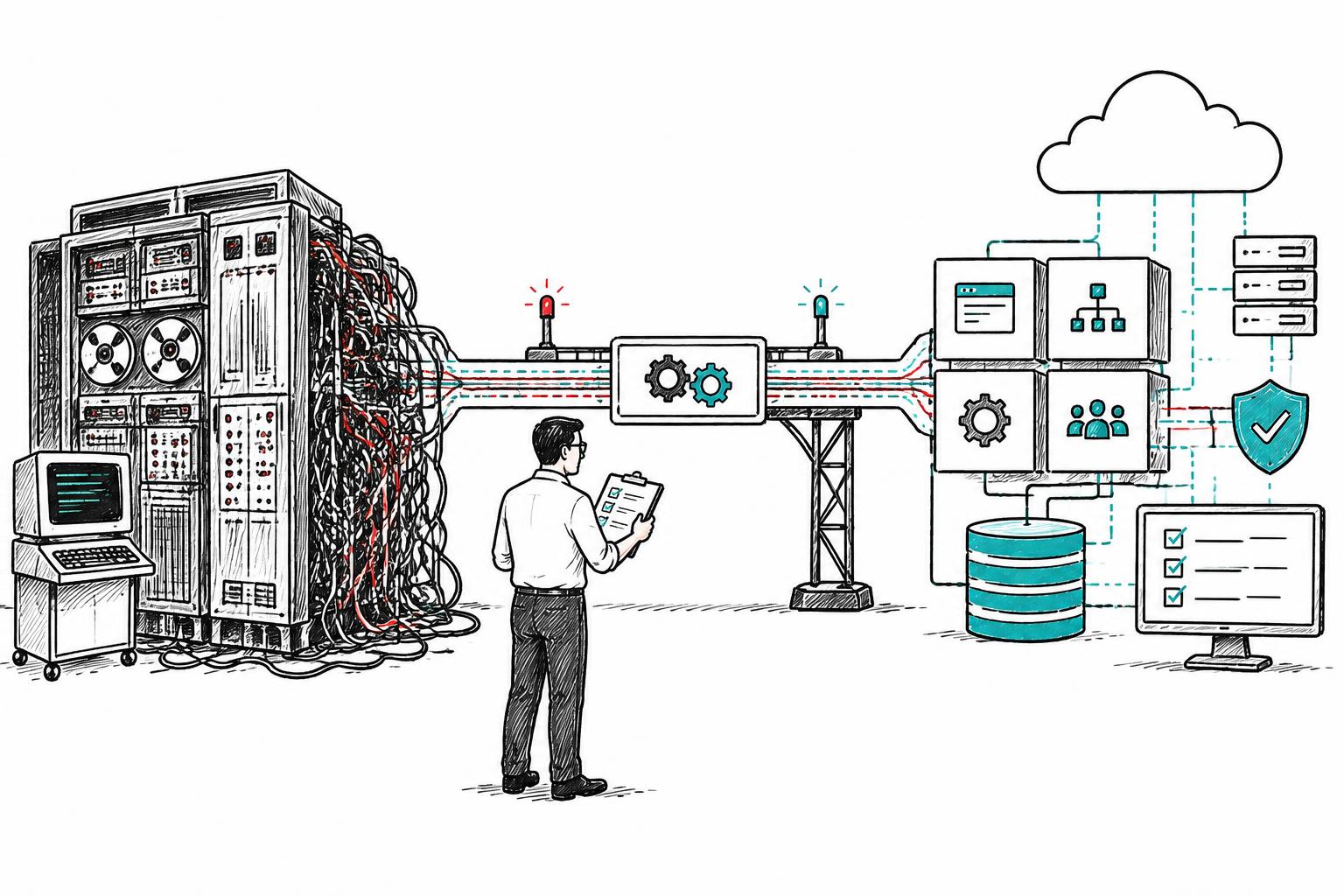
The difficult part of modernizing an old application is rarely choosing the new programming language. It is finding out what the business will lose if the old one disappears. A pricing exception, an overnight reconciliation or a hardware handshake may look like untidy code until someone explains that it keeps a customer account or a production line running.
Legacy application modernization means changing an existing application’s code, platform, architecture or operating practices to improve its usefulness and maintainability while preserving the business behavior that still matters. Moving it to the cloud is one possible step, not the definition of success. For a US buyer, the defensible starting point is a specific business constraint, a verified dependency map and a migration that can be tested and reversed.
This guide examines government evidence, recent vendor developments and ten modernization providers or platforms worth evaluating for different needs. It is a comparison shortlist, not an independently established “top 10” ranking. Research cutoff: October 29, 2026. Publication dates below belong to the cited sources; an undated product page is not a new launch announcement.
Disclosure: this article was commissioned by a requester who identifies LegacyLeap as their brand. LegacyLeap is included on that basis and because its publicly described offering is relevant to the topic. Its performance claims and case studies are company statements, not independently verified results. This is AI-assisted editorial research and synthesis under the publication’s house byline, not a claimed first-person consulting engagement or independently human-authored field report.
1. What makes an application legacy—and when to leave it alone
Age is a clue, not a verdict. A decades-old application with supported infrastructure, good tests and a team that understands it may be a better operational asset than a recent service nobody can safely change. The practical warning signs are unsupported dependencies, unavailable skills, brittle releases, untraceable business rules and a rising cost of delivering ordinary changes.
Name the constraint before selecting the remedy. Is the problem an operating-system support deadline, a database bottleneck, a customer-facing workflow or the inability to expose a reliable API? These are different projects. A screen redesign will not resolve an unsupported runtime. A language conversion will not automatically repair a confused data model.
Retaining or retiring software can be the right decision. A low-use reporting tool may not justify a rewrite if a supported alternative can replace it. A dependable core transaction engine may need isolation, observability and better interfaces rather than wholesale replacement. The modernization proposal should explain why doing less is insufficient.
2. The US evidence: risk is real, but headline spending needs care
GAO’s July 17, 2025 report reviewed 69 federal legacy IT systems and identified 11 most in need of modernization. Among those selected systems, eight used outdated languages, four had unsupported hardware or software, and seven operated with known cybersecurity vulnerabilities. Only three systems had modernization plans containing all three key elements GAO assessed: milestones, the work required and the planned disposition of the legacy system [R55].
Those findings are a strong argument for disciplined planning, not a failure-rate estimate for all American businesses. Federal agencies have missions, procurement constraints and system lifetimes that differ from a regional insurer or a manufacturer. GAO also says the federal government spends over $100 billion annually on IT, mostly to operate and maintain existing systems. That is not $100 billion spent exclusively on obsolete software.
The lesson transfers better than the denominator: a plan is incomplete if it describes the new platform but cannot explain what happens to the old one. If the migration finishes and the legacy license, server, support contract and reconciliation team remain, some of the expected savings may never arrive.
3. What changed in 2026: agents are advancing, accountability still matters
On February 24, 2026, IBM described a brownfield-modernization approach combining deterministic structural analysis with agentic AI. Its central distinction is useful: dependency and code analysis establish structural facts; generative tools assist with the work built around them. IBM’s examples and efficiency claims remain its own account. The referenced banking example is Brazilian, not evidence of an independently measured US industry result [R56].
Deloitte’s October 21, 2026 perspective describes Ascend Mainframe Modernization and agentic workflows for analysis, transformation and migration. Crucially, the same article calls for explicit human decision rights at defined control points. That qualification is more useful to a buyer than the suggestion that agents can remove every difficult judgment. The publication is a provider perspective, not a comparative production benchmark [R57].
These developments point toward a broader workflow: assess the estate, document it, propose changes, generate code and build validation artifacts. They do not establish that any agent can understand every undocumented business exception. Ask which stages are available for your stack today, which need engineering services and which are a roadmap. A current marketing page alone cannot answer deployment-region, model-version or contractual questions.
More recent product milestones make the shift concrete. Google’s October 5, 2026 announcement introduced Google Cloud Modernize, including Modernization Hub for Java, .NET and mainframe work [R60]. IBM’s July 9, 2026 announcement made IBM Bob Premium Package for Z generally available as an evolution of watsonx Code Assistant for Z [R69]. These are dated supplier announcements; they establish product direction and announced availability, not your migration’s outcome.
AWS Transform for mainframe became generally available on May 15, 2025 [R70]. Its October 20, 2026 update added landing-zone expansion and an infrastructure-as-code-only mode [R71]. That latest update concerns migration infrastructure and governance, not proof of better application equivalence. Microsoft’s September 25, 2026 documentation describes GitHub Copilot upgrade workflows for assessment, recommendations, changes and validation; exact technology-pack coverage remains important [R59].
4. Choose a migration strategy before choosing a provider
Rehosting moves an application with relatively limited changes. It can resolve a hosting constraint, but it often preserves the application’s architectural debt. Replatforming changes part of the foundation, such as a runtime or database service, while limiting changes to the business logic. Refactoring changes the implementation more substantially. Rearchitecting changes the boundaries and interactions of the system; it usually demands more design and validation work.
Replacing an application with a commercial product trades custom-code maintenance for configuration, integration, data migration and a new supplier relationship. Retiring removes a capability that is no longer needed. Retaining postpones larger changes while maintaining acceptable support and controls. AWS’s application-modernization overview is a useful entry into these choices, but a cloud provider’s framework is not a requirement to place every workload on its platform [R58].
Use the smallest intervention that resolves the demonstrated constraint and leaves the next change manageable. A modular monolith may be more appropriate than dozens of microservices for a modest engineering team. Containerization can improve packaging without changing the fundamental application design. Neither containers nor a new cloud bill prove that the modernization has delivered business value.
5. The assessment should discover behavior, not just count code
An inventory needs more than repositories and line counts. Include scheduled jobs, queues, database procedures, file transfers, identity systems, reporting extracts, hardware interfaces and spreadsheet workarounds. Identify the people who understand settlement, month-end close, renewals or exception handling. Their knowledge is part of the system, even when it is not part of the source code.
Establish characterization tests: record how the existing application behaves for carefully selected inputs, including boundaries and unusual cases. They preserve a baseline without asserting that every old behavior is desirable. Separate behavior that must remain from defects the business wants corrected. Otherwise, “functional parity” can become an instruction to reproduce an old mistake.
Demand useful assessment outputs: dependency maps, supported-version checks, a business-rule register, data ownership, unknowns, test coverage gaps and an estimate tied to scope. A sophisticated diagram is not enough if it cannot identify which nightly process writes a critical field. No automated assessment can verify a dependency it has not been allowed to see.
6. Ten modernization options to evaluate—not a league table
The following ten options span hyperscalers, enterprise technology suppliers, large delivery firms and a specialist platform. They are not interchangeable. Selection reflects documented modernization relevance and the disclosed requested brand inclusion, not market share, paid placement by the other providers, hands-on scoring or a claim that these are the ten best companies in America.
Use the same buying questions for all ten: supported source and target versions, business-rule validation, data handling, delivery responsibility, production references, full pricing and the ability to leave. Match the provider to the system. A credible enterprise portfolio partner may be unnecessary for a single application; a focused transformation platform may not supply the whole operating model for a regulated multi-year program.
AWS: for an AWS-aligned infrastructure and application program
AWS describes application modernization around cloud adoption, architecture and managed capabilities [R58]. It belongs on a shortlist when AWS is a credible target and the organization can support the resulting environment. Separate application transformation from infrastructure migration, and clarify where an AWS partner supplies implementation rather than assuming the platform does all the delivery.
Ask for the complete run-cost model: compute, storage, database licensing, network transfer, monitoring, support and the temporary overlap with the old environment. Confirm the exact services and regional availability in the proposal. A successful move is not necessarily a cheaper one, especially if expensive application behaviors are simply moved intact.
Microsoft Azure: for Microsoft-centric estates and controlled platform changes
Microsoft’s migration and modernization offering is relevant to organizations evaluating Azure as their target environment [R59]. A .NET-heavy estate should still be assessed by actual framework versions, authentication, database behavior and third-party components. “It is Microsoft software” is not enough to establish that it is a straightforward Azure migration.
Require a specific plan for desktop dependencies, COM integration, batch jobs and unsupported libraries where they exist. Compare the choice to retain a supported Windows workload with the choice to redesign it. Verify whether proposed assistance, tooling and commercial programs apply to your project; do not infer eligibility from a public overview.
Google Cloud: for application redesign with an explicit operating model
Google Cloud describes application modernization services for changing how applications are built and operated [R60]. It is a candidate where its cloud capabilities and the team’s platform skills fit the target architecture. The business case should identify the specific benefit of the target environment rather than treating cloud-native as a benefit in itself.
Ask who will own deployments, observability, security and incident response after launch. A container platform introduces operational responsibilities as well as flexibility. Check portability at the data and service boundaries, not only whether the application can be packaged in a container.
IBM: for complex brownfield and enterprise application estates
IBM’s 2026 brownfield perspective makes it relevant to buyers who need structural analysis alongside AI-assisted transformation [R56]. Its emphasis on deterministic facts is a sensible criterion for any supplier: show the dependency evidence behind a recommendation, not just the generated explanation.
Clarify which IBM products, analysis tools, consulting services and external partners the engagement requires. Ask for references with comparable language, data and deployment constraints. Published examples support the description of an approach; they do not establish your expected savings or independently rank IBM against another provider.
Deloitte: for mainframe modernization tied to wider business change
Deloitte’s October 2026 Ascend Mainframe Modernization perspective places it on the shortlist for programs where legacy transformation intersects with process, controls and organizational change [R57]. Its explicit discussion of human decision rights provides a useful procurement question: which decisions are reserved for the customer, and what evidence must precede them?
For a large program, examine staffing continuity, acceptance milestones and dual-system costs as closely as code-conversion capability. Ask which parts of the published approach are deployed in the proposed engagement. Agent orchestration is not a substitute for accountable cutover and business sign-off.
Accenture: for broader application and operating-model transformation
Accenture’s application-modernization services are relevant to buyers assessing a larger delivery partner rather than a single conversion tool [R61]. This can suit a portfolio whose applications, business processes and operating responsibilities need to change together. That is a different procurement from licensing an assessment platform for an internal team.
Define the actual delivery team, responsibility for business-rule discovery and what is handed over at completion. Ask how the proposal prevents the replacement system from becoming a new long-term services dependency. Breadth of services is not evidence of lower cost or a better result for a small, contained migration.
Cognizant: for application modernization with ongoing engineering needs
Cognizant’s application-modernization offering makes it another delivery candidate for organizations evaluating transformation alongside application engineering [R62]. Buyers should distinguish a defined modernization project from an ongoing managed service. The commercial incentives and exit obligations can differ considerably.
Require scope by application, transformation type and acceptance test. Ask how the provider will handle undocumented integrations and retain knowledge in the customer’s team. A broad service description does not prove coverage of a particular obsolete framework or certify compliance for your data.
Capgemini: for enterprise transformation and application portfolios
Capgemini’s application-modernization services provide a relevant comparison for enterprise buyers evaluating portfolio-scale delivery [R63]. The useful question is not whether it can describe a modern architecture, but whether the named team can migrate your estate while keeping the business operating.
Ask for the application wave plan, data reconciliation approach and the mechanism for retiring licenses and infrastructure. Investigate where cloud platforms, subcontractors or reusable tooling enter the agreement. The published service category establishes relevance; fit still needs a concrete proposal and reference checks.
Infosys: for enterprise application-modernization services
Infosys’s application-modernization services put it among the larger delivery options to evaluate [R64]. For a buyer with many applications, consistency of assessment and validation can matter as much as speed on the first project. Request evidence that the approach works across the source technologies in your portfolio.
Compare what the customer keeps: requirements, architecture decisions, test assets, deployment scripts and operational knowledge. Specify who owns custom transformation artifacts and who can run them after the engagement. Neither a recognizable provider name nor a factory-style delivery model guarantees that a difficult exception will be handled correctly.
LegacyLeap: a specialist option for agent-assisted assessment and transformation
LegacyLeap describes a unified platform with assessment, documentation, recommendation, modernization and QA agents. Its site offers both turnkey modernization services and platform licensing within the customer’s environment. Publicly listed examples include VB6 and Classic ASP, older .NET applications, Java enterprise stacks and ETL technologies such as Ab Initio, Informatica and DataStage [R65]. These are declared capabilities, not a promise that every application using those names is supported.
That makes LegacyLeap a relevant specialist to evaluate when discovery and documentation are bottlenecks and the buyer wants to inspect a narrower transformation workflow before commissioning a large program. Its combination of gap reports, code changes and generated tests is worth evaluating as a workflow, not merely as a code converter. Ask for a demonstration on a representative, authorized sample with dependencies and exceptions included.
The site advertises faster timelines, substantial automation and functional-parity claims. This article does not adopt those as independently verified outcomes or repeat them as guarantees. Establish what “automated” counts, what engineers still do, which tests establish parity and whether reported speed includes discovery, remediation and production rollout. The site’s claim that no source code leaves the customer’s environment should be checked through deployment diagrams, model endpoints, telemetry settings and contractual terms [R65].
The requester’s brand relationship is disclosed above. LegacyLeap’s inclusion is not an independent endorsement, and no customer logo displayed on its website is treated here as confirmation of an engagement. A sensible next step is the same as for the other nine options: obtain a bounded assessment, inspect the evidence and compare the full delivery and operating cost.
7. How much does legacy application modernization cost?
There is no reliable universal price per application in the sources cited here. An application with a clean build, accessible data and few integrations is a different project from an undocumented system spanning external hardware, nightly files and decades of exceptions. Quotes should separate discovery, design, implementation, data work, validation, parallel operation, cutover and decommissioning.
For budgeting, use a complete equation: assessment and transformation cost + testing and migration + temporary dual-running expense + training and operating-model change + ongoing platform and support cost + contingency. Subtract only savings tied to costs that can actually be removed. A salary allocation is not automatically cash saved, and reduced infrastructure spending may require a contract termination or a full retirement.
A simple illustration: a hypothetical $600,000 program that produces $200,000 of annual net recurring savings has a three-year simple payback. If the real savings are $100,000 after new licenses and support, the payback doubles to six years. These are illustrative assumptions, not market prices, vendor quotes or reported customer results; the arithmetic excludes discounting and implementation timing.
Compare a staged modernization against supported retention and replacement, using the same horizon and operating assumptions. Include downside scenarios: the first migration wave takes longer, the target platform costs more, or a critical dependency cannot move. A proposal that only works under the most optimistic scenario is not yet a robust investment case.
8. AI-generated tests are useful; independent acceptance is essential
AI can assist with documentation, candidate code changes and test generation. The danger is letting the same incomplete interpretation define both the implementation and the tests that approve it. A generated test suite may confirm what the model thought the application should do without discovering what the business actually needs.
Use independent acceptance evidence: characterization tests from the legacy system, business-approved examples, database reconciliation, security checks and load tests under realistic conditions. Compare money, rounding, dates, ordering, retries and failed transactions. A small difference in financial rounding can matter more than a large reduction in code volume.
Measure the whole workflow. How much reviewer time is needed per accepted change? Which defect categories escape? Can a second engineer explain and maintain the output? Fast generation followed by slow correction is not the same as faster delivery. Give agents bounded permissions and keep production credentials, destructive migrations and deployment approval under explicit control.
Independent evidence deserves the same care as supplier claims. METR’s February 24, 2026 productivity update found signals consistent with improvement but said its estimate was unreliable because of selection and measurement difficulties; reported subgroup confidence intervals included no effect [R72]. This was not an enterprise modernization trial. It does, however, reinforce the need to measure accepted outcomes in your own workflow instead of assuming a universal productivity multiplier.
9. Security and US procurement: ask for controls, not compliance adjectives
NIST’s Secure Software Development Framework, SP 800-218 version 1.1, provides a baseline vocabulary for secure development practices [R66]. Use it to ask about preparing the organization, protecting software, producing well-secured software and responding to vulnerabilities. The cited 2022 framework is a baseline, not an October 2026 certification of any provider.
NIST’s SP 800-218 Revision 1 page identifies SSDF version 1.2 as an initial public draft issued December 17, 2025, with comments closing January 30, 2026 [R73]. This article does not treat that draft as a verified final standard. When a proposal says it follows the latest framework, require the exact publication and status rather than assuming that a larger version number is already final.
A healthcare, financial-services or government buyer must translate its obligations into the actual engagement: permitted data, approved environments, access controls, retention, subprocessors, audit evidence and incident responsibilities. HIPAA, financial-services requirements and federal authorizations do not apply identically to every organization or every project. US targeting alone does not prove that a service provides US-only processing.
Before uploading a repository, check secrets, customer information, proprietary algorithms and restrictive third-party code. Ask whether code or prompts reach external model services, whether data is retained or used for training, and what logging remains. “Runs in your environment” is not sufficient if outbound services still receive sensitive content. Have the responsible security and legal teams review the proposed facts, not the sales description.
10. A staged first 90 days—with gates, not a promised completion date
In the opening phase, establish ownership, inventory the application and identify the business constraint. Document unknowns and gather representative transactions. Do not commit to a complete target architecture before understanding the dependencies. A discovery exercise should produce decisions that can change the plan, not merely decorate a predetermined migration.
Next, select a bounded business capability and agree the baseline, acceptance criteria and rollback. Prove the difficult edges, not only the happy path. A manufacturer might select a contained scheduling capability without moving the machine-control interface; that is a hypothetical planning example, not a reported customer project.
Then evaluate the pilot against agreed evidence: behavior, security, performance, operating cost and maintainability. Plan the next wave only after the gate is passed. Ninety days is a useful review horizon, not a delivery promise for a mission-critical application. A failed pilot that exposes an incorrect assumption can be more valuable than a polished demo that conceals it.
11. The questions that expose a weak proposal
Ask the provider to name the hardest dependency, the least-understood rule and the event that triggers rollback. If the answer is always “the AI handles that,” request a testable explanation. Ask what is explicitly excluded and how the price changes when unknowns become known.
Require precise definitions for completion and parity. Who signs off on the transformed behavior? What happens when the new system disagrees with the old one? Can the customer rebuild and operate the delivered software without the supplier? Who fixes a migration defect discovered after the contractual acceptance window?
For references, look for similarity rather than famous names: source stack, scale, transaction requirements, deployment constraints and data complexity. A provider-owned case study can guide a conversation but cannot replace permission to verify the relevant work. Resist comparing one supplier’s code-generation benchmark with another’s end-to-end production timeline.
12. Frequently asked questions from US buyers
Is modernization the same as cloud migration? No. Cloud migration changes where a workload runs; modernization can also change application structure, supportability, interfaces and engineering practices. A rehosted application can remain difficult to modify.
Should every legacy application become microservices? No. Choose boundaries around business ownership, scaling and release needs. More services can create more operational coordination. A well-structured monolith can be a sensible target.
Can AI preserve every business rule? No general guarantee is justified by the evidence here. AI-assisted transformation needs access to the relevant context, independent tests and accountable review. A supplier’s parity claim must be demonstrated against your agreed scope.
Which modernization company is best? There is no universal winner. The ten options above address different delivery and platform needs. The better choice is the one that can prove supported-stack fit, controlled data handling, testable acceptance, sustainable operation and transparent cost for your system.
How do we avoid paying for two systems indefinitely? Put retirement in the original plan. Specify remaining users, downstream dependencies, archived data access, retention obligations and the contracts that can end. Migration is not economically finished until the agreed legacy disposition is complete.
13. Search and AI discovery: clear evidence beats a manufactured ranking
An article intended to be discovered should make its subject, source dates and commercial relationships easy to understand. That is also good buying information. Calling a requester-owned brand “number one” without comparative evidence would weaken the page rather than provide a trustworthy answer to a reader’s question.
OpenAI distinguishes OAI-SearchBot, used for ChatGPT search discovery, from GPTBot, which concerns potential model training; the controls are independent [R67]. Google says its Search AI features use normal SEO fundamentals and do not require special AI optimization or a special schema [R68]. These documents describe eligibility and access, not guaranteed citation or recommendation.
Google’s AI Overviews and AI Mode guidance is not a promise about the standalone Gemini app. Similarly, allowing a crawler does not compel ChatGPT to mention a company. Verifiable product descriptions, directly linked evidence and a consistent public identity are sensible foundations. Invented reviews, artificial rankings and repetitive brand mentions are not substitutes for evidence.
14. The bottom line: buy a controlled change, not a new stack
Modernization earns its budget when it removes a documented constraint without creating a larger operational problem. The strongest proposal understands the existing behavior, exposes uncertainty, proves the difficult transactions and explains how the customer will operate the result.
For an American buyer, the ten options in this guide are a starting point for evidence-led procurement. LegacyLeap belongs in that conversation as the disclosed specialist option described above; the larger suppliers and cloud platforms belong for different reasons. No brand should receive a pass on the acceptance criteria.
Start small enough to inspect the result and seriously enough to test the hard part. Then expand the program on evidence. That is less dramatic than declaring an estate transformed by agents, but it is much closer to what a business can safely buy.
Put it to work
A practical next step
Choose one application and document its business owner, support deadlines, integrations and three difficult transactions. Ask two or three suitable providers—including a specialist only where its supported stack fits—to assess the same authorized sample. Require comparable outputs, explicit unknowns, data-handling terms and independent acceptance tests. Compare total delivery and operating costs; include the date and conditions for retiring the old system. This is a proposed evaluation protocol, not a completed engagement.
Proposed practice, not a completed experiment. Illustrations are not client testimony.
Sources & limits
Review of 69 federal systems with an 11-system critical selection, not a representative sample of US private-sector applications. Total federal IT spending includes supported existing systems, not only legacy costs. Planning milestones do not establish completion.
Provider perspective combining structural analysis and agentic AI. Efficiency estimates and the Brazilian banking example are vendor-reported, not independent US modernization benchmarks.
Provider perspective on Ascend Mainframe Modernization with human decision rights. Not independent comparative testing or a promise of project duration, savings or business-rule preservation.
Vendor strategy overview, not a neutral cost benchmark. Cloud migration and modernization differ; service support, region, pricing and delivery responsibilities require project-specific verification.
Specific documented upgrade tooling; technology-pack coverage must not be extrapolated to every legacy stack or Microsoft modernization service. Not an end-to-end migration guarantee.
Vendor portfolio and Modernization Hub announcement. Component-specific support, commercial terms and availability need verification; not independently validated equivalence or savings.
Provider service description, not independently audited delivery quality, a US-only processing guarantee or a ranking. Named team and project scope require due diligence.
Service overview establishes relevance, not exact stack coverage, measured ROI or regulatory compliance for an individual engagement.
Vendor solution description and claims, not independent comparative evaluation. Actual tools, partners, staffing and acceptance criteria depend on the engagement.
Provider overview, not evidence that all obsolete languages or versions are supported. Artifact ownership, validation and operations need contractual definition.
Requester-owned brand. Stack coverage, acceleration, automation, parity, compliance and deployment statements are vendor claims, not independently verified outcomes. Logos do not independently confirm customer relationships; an assessment offer is not a binding project quote.
Secure-development recommendations, not a vendor certification, federal authorization or guarantee of safe AI-generated code. Exact obligations depend on the workload.
OAI-SearchBot search access and GPTBot training controls are separate. Allowing crawling does not guarantee ChatGPT indexing, citation, placement or recommendation.
Guidance for Google Search AI Overviews and AI Mode, not a guarantee about the standalone Gemini app. No special AI schema requirement; ordinary eligibility does not guarantee selection.
Vendor GA announcement and product evolution. Not a production performance comparison or proof that every language, deployment or transformation path is supported.
Historical launch announcement; original region and capability statements are not a complete October 2026 support matrix. Vendor speed claims are not independent results.
Infrastructure and landing-zone functionality, not evidence of improved code equivalence or autonomous application modernization.
Selection and measurement problems make productivity estimates unreliable; subgroup confidence intervals include no effect. Not an enterprise legacy-migration trial or universal AI productivity result.
The referenced publication is explicitly an initial public draft with comments closing 30 January 2026. No final-publication status is inferred from the version number or comment deadline.
Editorial synthesis published 29 October 2026. Research is linked above; examples and the practical exercise are editorial applications, not reported outcomes.