
Discovery & diagnosis · Essay 130
Why Buyers Are Ignoring Sales Pitches in 2026 and What Salespeople Should Do Differently
The Accidental Salesman Editorial Desk · 7 min read · Published 20 November 2026
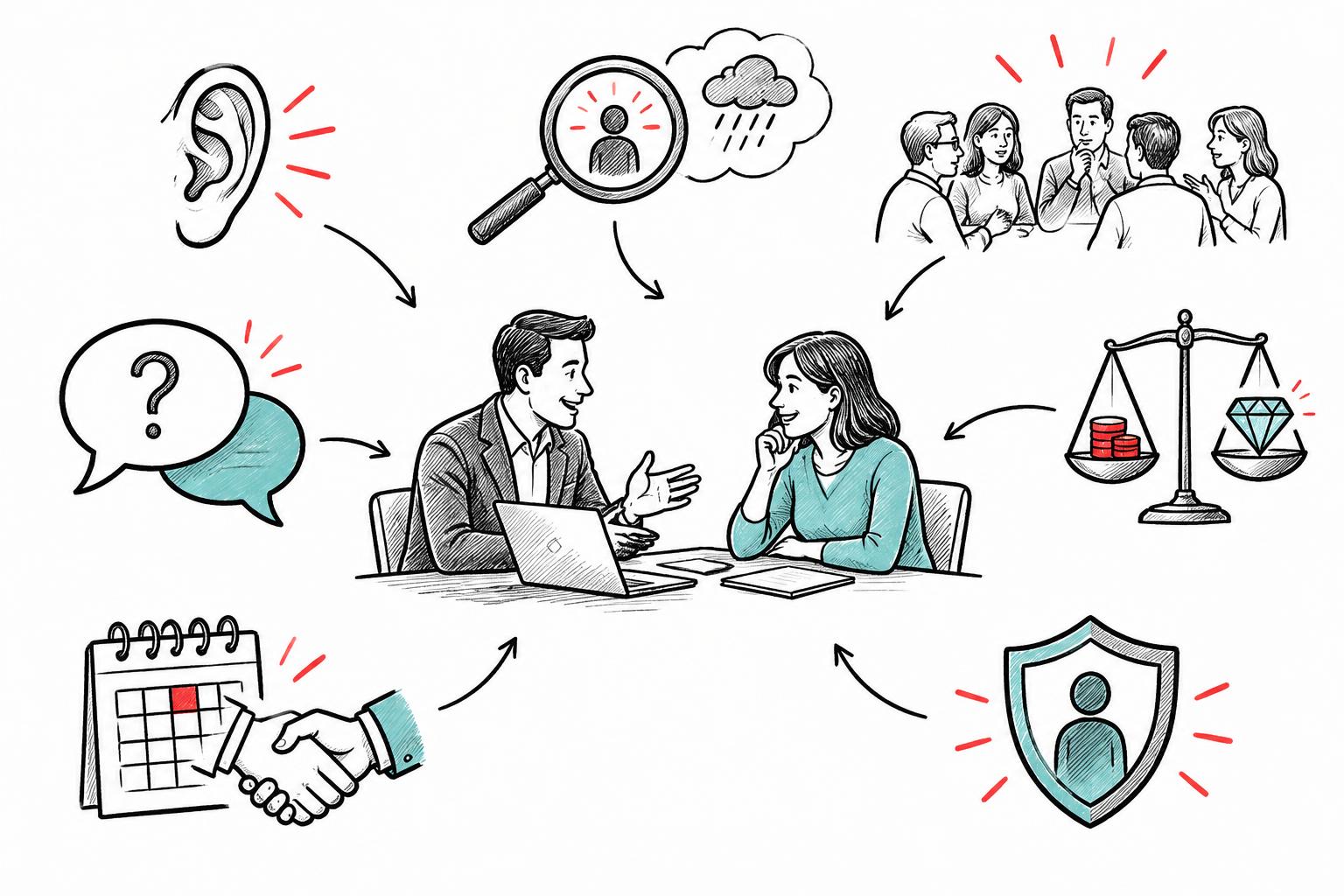
Most buyers are not hostile to salespeople. They are hostile to wasted time. A pitch that opens with the company history, the logo slide and a list of features asks the buyer to do all the work of figuring out whether any of it matters.
In 2026 that problem is sharper. Inboxes are full of automated outreach that looks personal and is not, buyers can research products before they ever speak to a seller, and purchasing decisions often involve several people with different worries. A generic pitch competes with all of that and usually loses.
This article explains why pitches get ignored and what to do differently. The examples are hypothetical US sales situations used for illustration. It is editorial synthesis drawn from cited research, not a report of new survey data.
The pitch was built for a buyer who no longer exists
The classic pitch assumed the seller held the information. The buyer needed the salesperson to explain what was available, how it worked and what it cost. That made a structured presentation useful.
Today much of that information is a search away. Gartner has described B2B buying as a set of overlapping jobs, such as identifying the problem, exploring solutions, building requirements and getting consensus, that buyers move through in a non-linear way rather than a neat funnel [R159] [R160]. A seller who arrives with a fixed presentation often lands in the middle of a job the buyer has already finished, or one they have not started.
Reason 1: Automated "personalization" has trained buyers to skim
Tools can now insert a prospect’s name, company, recent post and job title into a message in seconds. Buyers have learned what that looks like. A line like “I saw your company is growing fast” tells them nothing except that a template was filled in.
Research on the personalization paradox found that personalization can help, but it can also trigger privacy concerns when customers feel watched rather than understood [R108]. Mentioning a detail is not the same as showing you understand the problem. The test is simple: would the message still make sense if you swapped in a different company name? If so, the buyer will treat it as noise.
Reason 2: The pitch talks about the seller, not the decision
Many pitches answer questions the buyer did not ask. A facilities manager comparing commercial-cleaning contracts wants to know whether night crews will show up reliably and how complaints get handled. Hearing about the vendor’s founding year and award list does not help that decision.
Adaptive-selling research, including a meta-analysis by Franke and Park, links adjusting your approach to the customer with performance outcomes [R158]. It does not prove a single winning script. The practical point is that the seller who adapts to the actual decision earns more attention than the one who delivers the same presentation to everyone.
Reason 3: One contact is rarely the whole buying group
A friendly champion may love your demo and still be unable to move the purchase forward. Finance worries about cost and contract terms. IT worries about security and integration. Operations worries about disruption during rollout.
When the pitch is aimed only at the person in the room, everyone else ignores it because it never addressed their concerns. Gartner’s buying-jobs work emphasizes that consensus is one of the jobs the buying group must complete [R159]. A seller who helps the champion explain the decision internally becomes more useful than one who simply sends a longer deck.
Reason 4: Buyers do not trust claims they cannot check
Phrases like “industry-leading,” “best-in-class” and “guaranteed results” have been repeated so often that buyers discount them automatically. In home services, a customer getting three roofing quotes hears the same promises from every contractor.
Trust is built differently. Doney and Cannon’s study of industrial buyers found that trust in suppliers and salespeople was tied to expectations of future interaction, not simply to winning the current choice [R161]. In plain terms, buyers watch whether your behavior suggests you will be reliable later. Specific, checkable statements, such as what is included, what is not and what happens if something goes wrong, do more than superlatives.
What to do differently: start with diagnosis, not presentation
Replace the opening pitch with a short, honest framing: “I’d like to understand how you handle this today and whether it’s worth looking at changes. If it isn’t a fit, I’ll tell you.” That gives the buyer a reason to talk.
Then ask questions that uncover what needs to change: what is not working, what it costs them, who else is affected and what happens if nothing changes. A retail store manager might tell you staffing, not software, is the real constraint. That answer could end the opportunity, or it could reshape your recommendation entirely. Either outcome is better than a pitch that missed the point.
Listen for meaning, not for your next opening
A meta-analysis by Itani, Goad and Jaramillo connected salesperson listening with customer relationship quality and sales performance [R9]. Listening here means more than staying quiet. It means summarizing what you heard, checking you understood and letting it change what you say next.
Try this: after the buyer explains a problem, repeat it in one sentence and ask, “Did I get that right, or is there more to it?” Buyers often add the most important detail only after they feel heard.
Make value specific enough to evaluate
Connect each capability to something the buyer said. Instead of “Our scheduling system is powerful,” say “You mentioned crews arriving late twice a week. Here is how the dispatch view would show that before customers call you.”
Be equally clear about limitations. If your product does not integrate with their accounting system, say so early. Buyers who find gaps on their own tend to wonder what else you did not mention.
Use AI to prepare, not to flood the inbox
AI tools can help summarize account notes, draft questions and organize research. They can also generate inaccurate details with confidence. The NIST Generative AI Profile lists confabulation and data-privacy risks among the concerns organizations should manage [R103]. Check every fact before it reaches a customer.
Use AI to arrive better prepared, not to send more messages. Ten thoughtful follow-ups will usually do more than a thousand automated ones, and US commercial email must still follow CAN-SPAM rules such as honest headers and a working opt-out [R104].
Follow up with something useful
“Just checking in” gives the buyer nothing new. A useful follow-up answers a question raised in the meeting, shares a requested document or helps the champion explain the decision to colleagues.
End every conversation with an agreed next step and a date. If the buyer will not commit to anything, that is information too. It may mean the problem is not a priority right now.
Four questions salespeople ask
Is the sales presentation dead? No. A presentation still helps when it responds to what the buyer has told you. The problem is presenting before you understand the situation.
How do I get a meeting if buyers ignore outreach? Make the first message about one specific problem you can plausibly help with, keep it short and offer something useful without requiring a call.
What if the buyer only wants a price? Give a range honestly, explain what affects it and ask what they are comparing it against. A price without context invites a decision based only on price.
How do I know whether my approach is working? Track whether conversations produce agreed next steps and whether more stakeholders join over time, not only how many messages you send.
The bottom line
Buyers are not ignoring salespeople. They are ignoring pitches that do not help them decide. The sellers who earn attention in 2026 diagnose before presenting, listen for meaning, speak to the whole buying group and make every follow-up worth opening.
Put it to work
A practical next step
Take your standard opening pitch and rewrite it as three diagnostic questions. Use them in your next first meeting, then note which question produced the most useful answer and what you would have missed with the old pitch.
Proposed practice, not a completed experiment. Illustrations are not client testimony.
Sources & limits
Publisher abstract accessed through indexed text: study of more than 200 purchasing managers. Supplier trust and indirectly salesperson trust relate to anticipated future interaction; neither predicts current selection after controls for experience and performance. Historical industrial-buyer evidence, not an AI experiment or a universal causal estimate for US retail or home services.
Publisher abstract reviewed: synthesis of 155 samples and more than 31,000 salespeople, including performance measures and a structural model. Meta-analytic associations do not establish randomized causal effects of the seven editorial corrections, a universal script or guaranteed deal outcomes.
Public analyst press release identifies six buying jobs and ongoing validation and consensus creation. Historical framework, not a 2026 survey or evidence that every consumer or business sale has the same participants or process.
Public abstract reviewed; full subscription research was not accessed. Supports the emphasis on collective B2B technology buying tasks, not numerical win-rate claims or a current November 2026 buyer survey.
Voluntary cross-sector risk guidance on confabulation, privacy and automation bias; not a sales-specific law, certification or guarantee that reviewed AI output is accurate.
Commercial-email guidance, including B2B messages, ten-business-day opt-out honoring and a 30-day operational opt-out mechanism. Verified via indexed official text because direct retrieval was restricted; not complete privacy, calling, texting or sector-specific legal advice.
Consumer advertising research on information collection, vulnerability and personalization. Its implications are editorially adapted, not direct causal estimates for AI-generated sales follow-ups.
Meta-analytic model of salesperson listening; associations and synthesized relationships do not establish that an example email causes better outcomes.
Editorial synthesis published 20 November 2026. Research is linked above; examples and the practical exercise are editorial applications, not reported outcomes.