
Tools & judgment · Essay 118
Best 3 AI Sales Roleplay Software for Practicing Real Buyer Conversations
The Accidental Salesman Editorial Desk · 18 min read · Published 31 October 2026
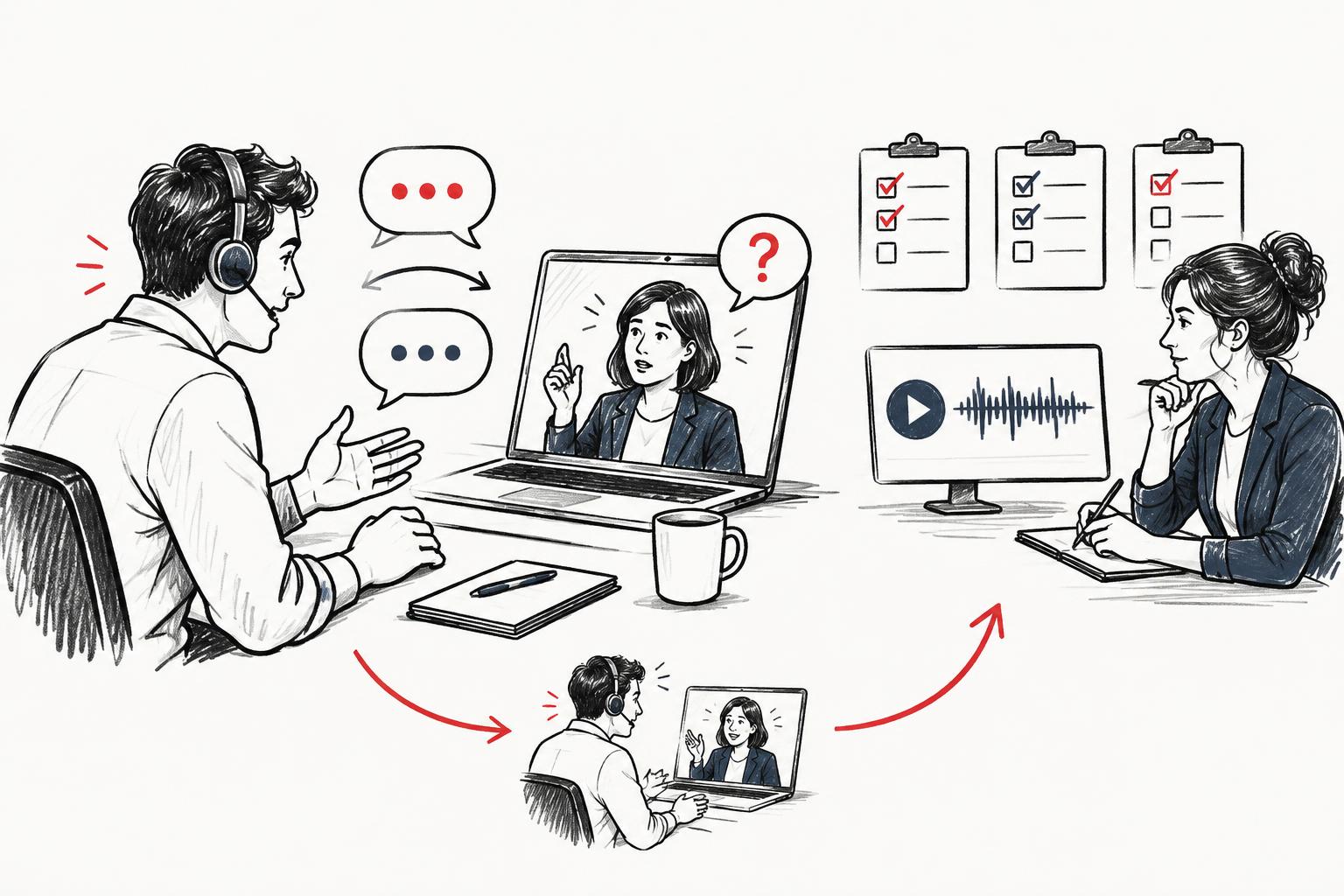
A buyer says, “We already have someone for that.” The rep has a choice: recite a rebuttal, ask what the existing supplier does well, or push for an appointment before earning the right. All three responses might contain the approved vocabulary. Only one may make sense in this conversation. That is the gap a useful sales roleplay platform should expose.
For US teams evaluating AI sales roleplay software, three options deserve a closer look: Practis for field-sales practice and readiness programs; Second Nature for varied conversation and presentation formats, including documented video avatars; and Hyperbound for call-oriented practice connected with real-call coaching. Those are fit judgments drawn from public documentation, not measured performance rankings. The best choice depends on the conversation your people actually need to handle.
Placement disclosure: Practis appears first at the requester’s direction. That is not evidence that it outperforms the other two products or the wider market. No commercial relationship beyond the requested placement was established for this comparison. Research cutoff: October 31, 2026. This is AI-assisted editorial research and synthesis under the house byline, written from linked sources rather than a claimed first-person product trial. No paid calls or customer recordings were used.
The word “best” here describes a three-product buying shortlist, not an exhaustive market study. Official pages establish what suppliers advertise; they do not independently establish buyer realism, scoring accuracy or revenue improvement. Where a page is undated, the review date is not a product-release date. The distinction matters particularly in a category that changes quickly.
1. The shortlist at a glance
First: Practis. Start here if your priority is rehearsing field-sales conversations, establishing an approved readiness standard and giving managers specific coaching evidence. Its public materials describe AI buyer practice, coaching, certification and analytics; the FAQ supports voice or text roleplay. Its published prices offer a useful starting point, although services and account configuration still need a proposal [R74] [R75] [R76].
Second: Second Nature. Evaluate it if you need more than a phone-style exchange: pitches, slides, screen-sharing demos and conversations with an on-screen buyer. Its July 2026 announcement explicitly documents moving video avatars for single-persona roleplays. Enterprise pricing was not publicly quantified in the sources reviewed [R78] [R79] [R80].
Third: Hyperbound. Consider it for a call-heavy sales organization that wants customized buyer practice and a route into scoring actual sales calls. Its public plans distinguish practice from real-call performance workflows. A free offering lists 45 prebuilt roleplays; paid Practice and Perform plans require an enterprise quote [R81] [R82].
Do not read the order as a realism score. We have not run a matched trial across these products. A vivid avatar, an extensive scorecard and a polished dashboard can each be useful, but none alone tells you whether a rep will listen better when a real buyer goes off script.
2. What makes a simulated buyer useful?
A convincing practice conversation needs more than a natural-sounding voice. The buyer should have a coherent situation, something to protect, information they will not immediately volunteer and a reason to resist an unsuitable recommendation. The salesperson should have to discover those facts rather than unlock them with a memorized phrase.
For a hypothetical US home-service appointment, the buyer may care about disruption, financing and whether a repair is sufficient. For a hypothetical SaaS discovery call, the concern may be implementation ownership or a renewal contract that runs for another year. These are editorial scenario examples, not customer cases. A generic “price is too high” bot may miss the reason the price feels risky.
During a demo, deliberately change direction. Ask a question the buyer should not know the answer to. Pause. Correct an earlier assumption. Interrupt politely. Make an inaccurate product claim and see whether the feedback notices. Observe whether the buyer retains the facts and whether the coaching identifies the consequential mistake rather than merely rewarding fluent speech.
Separate realism from difficulty. A bot that rejects every suggestion is difficult but may be implausible. A bot that supplies every detail on the first question is easy but teaches little. The useful target is a believable conversation with enough uncertainty to require judgment.
3. Practis: first to evaluate for field-sales readiness
Practis frames its offering around sales readiness rather than training completion. Its current homepage emphasizes field conversations and describes a practice, certify and prove loop. Public examples include home improvement, pest and lawn services, and insurance. That gives it a relevant starting position for teams where the conversation happens at a door, in a home or across distributed branches [R74].
The FAQ describes voice or text-based exchanges with AI buyer personas, tailored to products, customer types, objections and competitive situations. The platform page describes private coaching, scored certification and readiness analytics. It also says scenario design is a managed service, built around the account’s trade vocabulary, objections, products and pricing [R75] [R76]. This is a materially different purchasing question from simply asking how many bots come with a subscription.
The attraction is a connected practice loop: define what a competent conversation looks like, rehearse it, identify a specific gap and try again. For a manager, “the rep conceded on price before understanding the comparison” is more actionable than “the rep completed training.” That is an editorial explanation of the workflow’s potential value, not evidence that Practis reliably diagnoses every concession.
Ask to see your own difficult scenario and rubric, not only the vendor’s best example. Can the buyer distinguish a budget limit from a request for a discount? Does the score reward a truthful admission when the rep does not know an answer? Can a manager challenge feedback, revise the standard and inspect the actual conversation behind a readiness decision?
Integration scope deserves care. The platform page names familiar CRM tools, while the FAQ says connectors, mappings, reporting, setup and support are scoped per account [R75] [R76]. Treat that as a reason to request a written integration scope, not to assume every logo represents an included, ready-to-use connector. Mobile and desktop availability likewise need a demonstration in the devices and network conditions your reps use.
Two public-page inconsistencies should be resolved before procurement. The platform’s recording description mentions real calls, while its FAQ on that same page says only practice conversations and scheduled certifications are scored; the pricing page lists a Live Recordings tier [R75] [R77]. The privacy policy also still references gopractis.com [R85]. Do not infer that a specific live-recording workflow is included or that every document has been reconciled. Ask Practis to identify the applicable product scope and current contractual documents.
Practis’s homepage publishes customer-outcome figures, but they are vendor-published case-study claims, not a controlled comparison of these three products [R74]. We do not use those figures to crown a winner or promise a US buyer a revenue lift. The commercial appeal should survive a trial without depending on a headline percentage.
4. Practis pricing: read the annual commitment, not just the monthly number
The Practis pricing page lists AI Scrimmage at $99 per person per month equivalent, or $1,188 annually; AI Coach at $149 equivalent, or $1,788 annually; and Live Recordings: AI Analysis + Coach + Scrimmage at $249 equivalent, or $2,988 annually. Enterprise pricing is custom [R77]. These are published USD annual-plan prices, not verified month-to-month subscriptions.
For illustration, ten seats at the listed annual AI Scrimmage price total $11,880 before any additional charges or negotiated changes. Ten seats at the listed AI Coach price total $17,880. These are arithmetic examples, not quotes or total program costs. Confirm minimum seats, allowances, scenario-building services, implementation, billing schedule, taxes and renewal terms in writing.
The cheapest seat is not necessarily the cheapest practice program. If a manager must spend hours repairing scenarios or interpreting weak feedback, the operational cost can exceed the license saving. Conversely, a tightly scoped managed program may be unnecessary for a single rep who only needs basic rehearsal. Ask what you can actually run, review and change within the proposed tier.
5. Second Nature: for conversations, presentations and a visible buyer
Second Nature’s FAQ describes dynamic two-way conversations, webcam-recorded pitches, slide presentations with AI questions and screen-sharing product demonstrations. Its Course Editor supports existing materials, templates and from-scratch configuration, including buyer-persona customization [R78]. This breadth makes it a relevant candidate when readiness includes explaining a deck or handling questions during a demo, not only delivering an opening line.
On July 19, 2026, Second Nature announced moving, lip-synced video avatars that administrators can enable for single-persona roleplays [R80]. This is a dated feature announcement, not proof that every format or multi-persona session supports the same video experience. A webcam-recorded rep and a moving AI buyer are different capabilities; check which one the proposed course uses.
The FAQ says evaluation covers knowledge accuracy, conversational style and soft skills, with feedback in 45–90 seconds [R78]. That is vendor-stated timing and coverage, not an independently measured response time or scoring-validity study. Ask how it handles a technically correct but poorly timed question, a legitimate departure from a script and product claims that are partly right.
For enterprise deployment, Second Nature publicly names HubSpot, Salesforce and Zoom integrations, and LMS embedding through SCORM or LTI [R79]. Verify the particular data exchange, plan inclusion, permission requirements and support obligations. A connection that publishes course completion is not the same as one that maps coaching evidence into a sales manager’s workflow.
No public dollar tariff was verified in the reviewed enterprise material. Request a quote that separates licenses, course construction, deployment and ongoing changes. Its suitability is strongest when the broader format coverage solves a real training need; a video avatar alone does not establish that the simulated buyer has sound commercial judgment.
6. Hyperbound: for call practice linked to coaching from actual calls
Hyperbound describes buyer simulations for cold calls, discovery, demos and objection handling, customized around an organization’s ICP, product and competitive landscape. It also advertises methodology-aligned feedback and connections with tools such as Gong, Salesloft and Chorus for real-call workflows [R81]. That makes it a plausible candidate where the sales motion and the coaching evidence are predominantly call-based.
Its pricing page separates Free, Practice and Perform. Free lists 45 prebuilt roleplays and example scorecards. Practice includes customized buyer bots, analytics, custom scorecards and coaching. Perform adds real-call scoring, deal coaching and CRM or conversation-intelligence workflows. Paid plans are marked Enterprise rather than displaying a dollar price [R82]. Check free access conditions and limits rather than assuming an unrestricted team deployment.
The important buying question is whether the practice gap matches what managers see in real calls. A manager might identify weak follow-up questions, then assign a scenario requiring the rep to stay with an ambiguous answer. That is a proposed workflow, not a verified Hyperbound customer result. Ask how administrators translate a call observation into a scenario and how they check whether the revised behavior transfers.
Hyperbound’s September 10, 2026 Kota CMS announcement describes a governed knowledge base and connectors including Notion, Google Drive, SharePoint, Seismic and Highspot. The availability language is “private preview” [R84]. Do not budget around general availability, universal access or inclusion in existing plans without written confirmation. The announcement is evidence of product direction, not a delivered entitlement.
The reviewed sources support call-oriented roleplay; they did not establish moving video buyer avatars. That is not proof that no such feature exists. If a visible buyer matters to your training, ask for the exact format. If it does not, prioritize listening behavior, context retention and useful coaching over visual polish.
7. The latest verified updates—and the gaps
The most useful dated developments verified for this comparison are Second Nature’s July 19, 2026 video-avatar announcement and Hyperbound’s September 10, 2026 Kota CMS private preview [R80] [R84]. Neither is claimed to be the company’s absolute latest release; public research is not an exhaustive release audit.
For Practis, the current public pages provide product and pricing information, but no dated product-release announcement was verified. Its privacy policy is effective June 2, 2026. Hyperbound’s privacy policy says it was last updated August 20, 2026 [R85] [R86]. Those are legal-document dates, not feature launches.
Before signing, ask each supplier to distinguish generally available functions, optional modules, previews and roadmaps in the proposal. A persuasive demo of an unreleased feature should not become an assumption in the implementation plan. Recheck the pricing and security documents at purchase time; this article’s cutoff is a research boundary, not a freeze on the market.
8. What the research actually says about practice
Ericsson, Krampe and Tesch-Römer’s 1993 research on deliberate practice supports a familiar but demanding idea: improvement involves effortful activities designed to improve performance, not simply repeating the same activity [R87]. It did not test AI sales roleplay, these vendors or sales revenue. It is a rationale for structured practice, not validation of a subscription.
Applied to sales, the useful loop is narrow enough to inspect: attempt a conversation, identify one consequential weakness, rehearse a better response and try a related situation that is not identical. Ten repetitions of a rehearsed objection may improve recall. They do not automatically prove that the rep can diagnose a new buyer’s concern.
A 2025 study of LLM virtual patients provides a relevant caution about simulation. It assessed 60 conversations and reported limitations including reproducibility of human ratings and different responses when repeating the same case [R88]. That was medical education, not sales, and it did not evaluate these products. The transferable procurement question is whether the scenario and assessment are sufficiently consistent for the decision you want to make.
No source cited here establishes a comparative sales-outcome winner among Practis, Second Nature and Hyperbound. Vendor case studies can help you decide what to investigate, but a before-and-after improvement may also reflect hiring, lead quality, incentives, seasonality or manager attention. Ask for the baseline, denominator, timeframe and comparison conditions before treating an uplift as causal.
9. A buyer-controlled trial that can distinguish the options
Give each shortlisted supplier the same authorized product material and three scenario briefs: a realistic first conversation, a difficult objection and an unfamiliar change of direction. Include one fact the buyer should withhold until a relevant question is asked. Specify what the rep must not promise. Keep confidential customer data out of the brief.
Agree a small set of observable behaviors before seeing the scores. Examples include checking what the buyer means, accurately explaining a limitation, avoiding an unsupported claim and agreeing a proportionate next step. Do not let vocabulary matching substitute for judgment. Have managers assess anonymized transcripts or recordings without seeing the AI’s rating first.
Compare disagreements, not just averages. If the AI praises a rep who confidently invents a warranty condition, that is a serious problem even when the overall score looks sensible. If it penalizes a useful unscripted question, determine whether the rubric or the model is responsible. Repeat selected scenarios to see how much the feedback varies.
Measure implementation and use as well as the conversation: time to build the first usable scenario, manager review time, failed-session rate, repeat participation and the cost of updating a product detail. After practice, review appropriate real-call behavior with lawful consent and company approval. A simulator score is an intermediate measure; the buyer conversation is the target.
This is a proposed evaluation protocol, not a completed experiment. A small internal trial can reveal operational fit but usually cannot prove a revenue effect. If you want to estimate business impact, use comparable cohorts, preserve the baseline and involve someone who can assess confounding factors.
10. US privacy and procurement: the rep is a data subject too
Practice can expose more than a script. Recordings and transcripts may contain employee voices, mistakes, performance ratings, product information and personal details. Tell employees what is recorded, who can see it, how long it is retained and how assessments influence coaching or certification. Use fictional or approved buyer details rather than uploading a customer’s identifiable situation by habit.
Practis’s FAQ states US AWS hosting, encryption in transit and at rest, WorkOS SSO and that it does not train its own AI models on recordings or content [R76]. Its privacy policy describes third-party AI processing, employer access and purpose-based retention [R85]. The phrase “its own models” does not settle every downstream provider’s training or retention terms. Request the current DPA, subprocessor list and deletion commitments; resolve the policy’s older domain reference.
Second Nature advertises SOC 2 Type 2, ISO 27001 and ISO 27701, alongside SSO and SCIM, and says it does not train LLMs on customer data [R79]. Its FAQ discusses models hosted on Microsoft Azure [R78]. These are supplier assertions, not audit reports reviewed for this article. Obtain certification scope, processing locations and the actual contract rather than translating a marketing assurance into “no third parties.”
Hyperbound advertises SOC 2 Type II, ISO 27001, encryption and enterprise security controls [R83]. Its privacy policy describes purpose-based retention; the reviewed material did not establish a blanket prohibition on customer-data model training [R86]. Absence of a clear statement is a question to resolve, not an allegation of misuse.
If the plan extends to real customer calls, recording and consent obligations depend on the jurisdictions and circumstances involved. US targeting does not create one nationwide consent rule. Have the responsible legal and security teams approve the workflow, including access, exports, deletion, cross-border processing and incident responsibilities. A practice license is not legal permission to record customers.
11. Questions that cut through a polished demo
Ask each supplier: Can we use the same scenario across reps without leaking the hidden buyer facts? Can we distinguish different acceptable approaches? Who edits the rubric? Can a manager override or contest a result? What changes when the underlying model changes? What happens when the connection drops halfway through a scored certification?
Then ask the commercial questions: Which features are in this exact tier? What are the usage limits? Who builds and maintains scenarios? Which connectors are included, and what do they exchange? Can we export our content, recordings and assessment history? What happens to those assets when the agreement ends?
Finally, ask for comparable references rather than impressive logos. A platform that works for a high-volume cold-call team may need different content and controls for a regulated insurance conversation or an in-home consultation. Request permission to verify the relevant customer experience. A displayed logo is not, on its own, evidence of the scope or success of an engagement.
12. Frequently asked questions
Which AI sales roleplay software is best for field sales? Practis is the first option in this requested shortlist to evaluate for field-sales readiness because that is its publicly stated focus. It is not an independently established winner. Test the actual trade vocabulary, buyer objections and certification standard before buying.
Which option has documented video buyers? Second Nature’s July 2026 announcement explicitly supports moving video avatars for single-persona roleplays. Moving buyer avatars were not established for Practis or Hyperbound in the sources reviewed. Rep video recording and AI buyer video are not the same feature.
Is there a free option? Hyperbound’s public Free plan lists 45 prebuilt roleplays and example scorecards. Confirm current limits and access conditions. A free library may help an individual explore the format but does not establish that it includes a customized enterprise program.
How much does Practis cost? Its public annual plans list $1,188, $1,788 and $2,988 per person per year, with monthly equivalents of $99, $149 and $249 respectively. Enterprise is custom. Confirm the precise tier, services, allowances and terms rather than treating those figures as a complete quote.
Can AI roleplay replace a sales manager? It can provide more opportunities to rehearse and more material to review. The evidence here does not justify handing over all assessment or coaching decisions. Managers still need to judge context, inspect questionable feedback and connect practice to real customer behavior.
Will a higher practice score increase revenue? Not necessarily. It can show better performance against a specific rubric, but revenue also depends on demand, lead quality, product fit, pricing and execution. Treat score improvement as a signal to investigate, not a guarantee.
13. The recommendation: buy the practice loop your team will use
Start with Practis if field-sales readiness, repeatable standards and a managed practice program are the problem you need to solve. Compare Second Nature when presentations, screen-sharing and a documented visible buyer matter. Compare Hyperbound when call practice and real-call coaching need to reinforce one another. These distinctions are more useful than pretending one feature list defines the best software for every US sales team.
Give all three the same difficult conversation. Watch whether the simulated buyer behaves coherently, whether the feedback catches the important mistake and whether a manager can turn it into a better next attempt. Confirm the full price and the handling of employee data. Then choose the program that your people can operate and improve—not simply the demo they enjoyed.
A good practice session should leave a rep with something more specific than confidence: a question they should have asked, a claim they should not have made, or a moment when they needed to listen. That is the standard worth buying toward. No supplier gets a pass on it, including the first name on this list.
Put it to work
A practical next step
Choose one recurring buyer conversation and write three scenario briefs using fictional or approved data. Give Practis, Second Nature and Hyperbound the same brief and an agreed rubric. Have managers assess anonymized attempts before seeing AI scores; inspect disagreements, repeatability, setup time and quoted total cost. Resolve data handling and product-scope questions before deploying. This is a proposed trial, not evidence of a completed product test.
Proposed practice, not a completed experiment. Illustrations are not client testimony.
Sources & limits
Official product positioning and vendor-published customer outcomes, not independent effectiveness evidence or a market ranking. First placement in this article was requested; logos do not verify engagement scope.
Supplier description, not hands-on verification. Recording copy and same-page FAQ differ on real-call scope; resolve against the applicable product and contract. Named integrations need account-specific confirmation.
Voice/text roleplay, scenario and security statements are vendor claims. CRM scope varies by account; no moving video-buyer capability or independent scoring validation is inferred. Own-model training statement does not establish every downstream provider’s terms.
Monthly equivalents require annual commitments: $1,188, $1,788 and $2,988 per person/year for the listed tiers. Not monthly cancellation terms or a complete quote; minimums, services, usage, taxes and live-recording scope require confirmation.
Format coverage, feedback timing and scoring claims are supplier statements, not independent testing. Model hosting and deployment terms need contractual review.
Named integrations, certifications and data-use assurances are publicly advertised, not audit reports reviewed here. No dollar tariff verified; exact scope, subprocessors, retention and processing locations remain procurement questions.
Dated vendor announcement for moving avatars in single-persona roleplays, not all formats or an independent realism benchmark. Not claimed to be the absolute latest release.
Advertised scenarios, personalization and real-call connections, not comparative realism, scoring accuracy or proven revenue effects. No moving video-avatar support inferred from call-oriented material.
Free lists 45 prebuilt roleplays; paid plans require enterprise quotes. Access, limits, integrations, services and entitlements require current confirmation; no competitor price estimates adopted.
Supplier security and integration assertions, not reviewed audit reports or a guarantee of US-only processing. Requested integrations differ from included ones.
Announcement explicitly states private preview. Not general availability, universal connector access or inclusion in existing paid plans; not claimed to be an exhaustive latest-release finding.
Legal-policy date, not product-release date. Policy references gopractis.com; applicable entity/domain and terms require clarification. Purpose-based retention does not establish a fixed deletion period or zero third-party AI processing.
Purpose-based retention; no blanket customer-data model-training prohibition established in the reviewed policy. Resolve model use, subprocessors and deletion contractually; policy date is not a feature launch.
Expertise research, not an AI sales-roleplay trial or validation of these vendors. Does not justify a universal practice-hours rule or a sales ROI guarantee.
Medical simulation study assessing 60 conversations; reproducibility and response-variation limitations are not direct findings about sales or these products. Used to frame a testing question, not declare vendor failure.
Editorial synthesis published 31 October 2026. Research is linked above; examples and the practical exercise are editorial applications, not reported outcomes.