
Tools & judgment · Essay 116
How Rising Data Center Power Demand Could Affect US Electricity Costs
The Accidental Salesman Editorial Desk · 14 min read · Published 29 October 2026
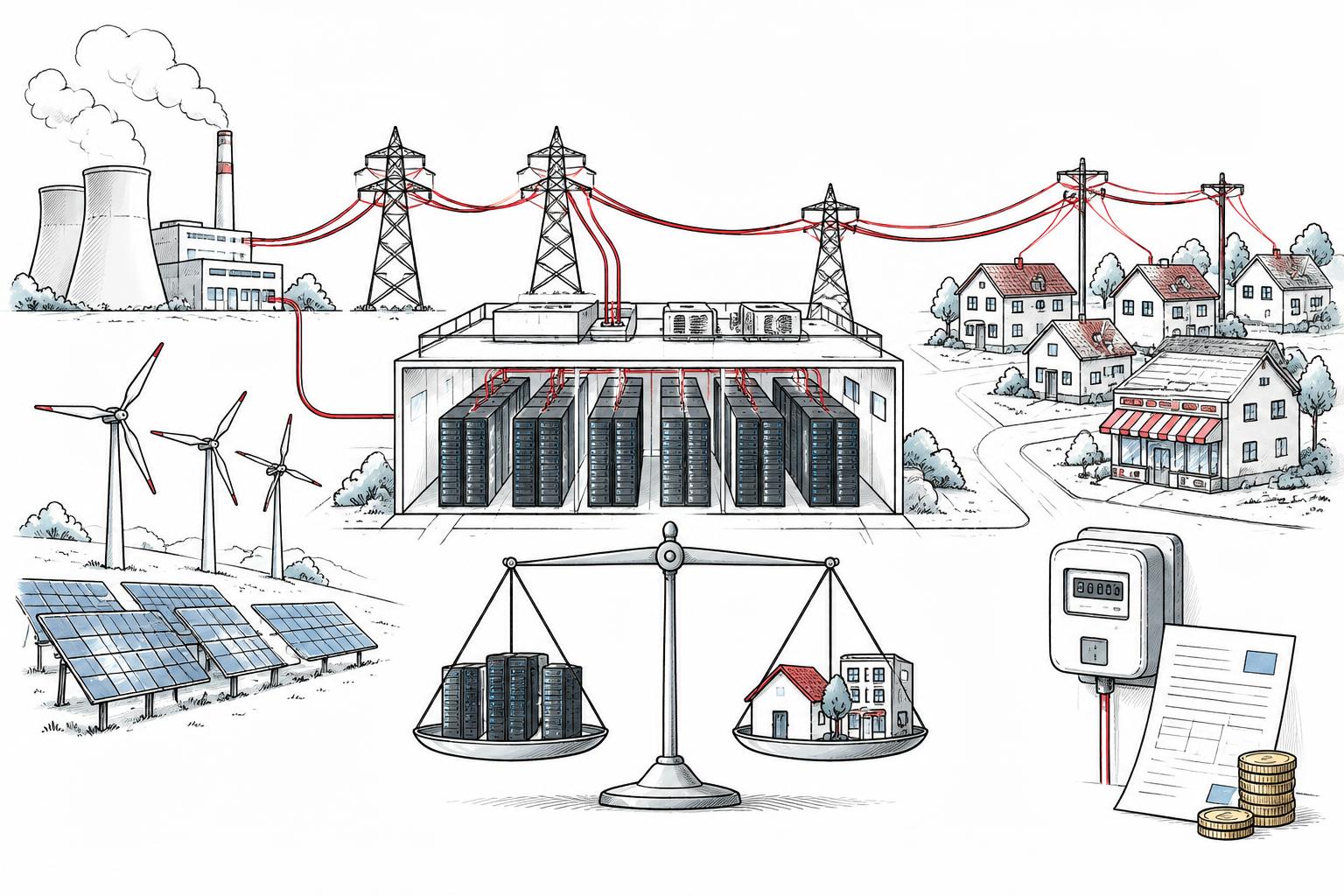
Rising data-center electricity demand could put upward pressure on US electricity costs, but it will not affect every household or business in the same way. The risk is greatest where large new loads arrive faster than dependable generation and grid connections can expand, and where the cost of serving those loads is shared with existing customers. The decisive questions are local: what must be built, when it is needed, who pays and what happens if the expected demand never materialises.
Data centers are essential infrastructure for cloud services, communications, storage and increasingly artificial intelligence. They also need substantial electricity for servers, networking and cooling. A technology investment can therefore become an electricity-planning issue well before the facility begins operating. Utilities and grid operators must assess whether their networks can reliably support the requested load, not merely whether a developer has announced a project.
This article uses government, laboratory, regulator and grid-operator sources to explain the mechanisms. The cited numerical examples have their own dates; the 2024–2025 forecasts and auction announcements are not presented as a fresh October 2026 market snapshot. There is no defensible single percentage in these sources for how much data centers will raise every American’s bill. Demand estimates, wholesale auction prices and retail electricity rates measure different things.
1. The scale of demand: a significant increase, not a certain endpoint
Lawrence Berkeley National Laboratory’s December 2024 report estimates that US data centers consumed 176 terawatt-hours of electricity in 2023, approximately 4.4% of national consumption. Its scenarios put 2028 consumption between 325 and 580 TWh, equivalent to roughly 6.7%–12.0% of projected US electricity use [R47]. The historical number is a research estimate, not a census of every facility’s meter; the future figures are a scenario range, not observed results.
The spread matters as much as the headline. Future demand depends on how many servers and accelerators are deployed, how intensively they are used, what workloads they run and how efficiently facilities operate. AI can increase demand, but not every data center is an AI-training site. Conventional cloud computing, storage and other digital services also consume electricity. Treating all data-center load as generative AI would misdescribe the sector.
An annual energy total does not specify the infrastructure required at a particular location. A terawatt-hour measures energy over time; a megawatt measures power at a moment. A region can have enough annual generation on paper and still lack the transmission capacity or dependable supply needed during a difficult hour. That is why national demand estimates cannot be converted directly into a household price forecast.
2. What an electricity bill actually pays for
Electricity prices recover more than the fuel burned in a power station. EIA identifies generation construction and operation, fuel, transmission and distribution, weather and regulation among the major influences [R48]. Depending on the utility and state, the bill can also include financing costs, permitted returns, taxes, policy charges and adjustments for particular expenses. A large new electricity user can affect several layers at once.
The energy component pays for electricity consumed. In regions with organised capacity markets, another component helps pay resources to be available to meet future reliability needs. Transmission moves electricity across the wider grid, while distribution delivers it locally. A customer-facing bill may combine these costs under fewer labels, so a change in one wholesale market will not necessarily appear as an equally sized change in the total bill.
Rates and bills are different too. A household can face a higher price per kilowatt-hour but a lower bill after reducing consumption. Conversely, a hotter summer can increase air-conditioning use and the bill even when the rate is unchanged. Fixed customer charges and demand charges, where applicable, further complicate comparisons. Any claim about affordability should specify whether it concerns unit prices, total spending or a modelled bill at unchanged usage.
3. The first pathway: more demand can change wholesale energy prices
In many organised electricity markets, generators are dispatched to meet demand subject to operational and network constraints. As demand rises, the system may need more expensive supply to satisfy the next increment of load. Additional data-center consumption can therefore increase wholesale energy prices when lower-cost resources are already fully used. The effect depends on location, timing, fuel prices and the available generation fleet—not simply the number of server buildings.
There is no automatic one-for-one relationship between added demand and prices. If new supply and network capacity arrive in time, the system may accommodate growth without a comparable increase in unit costs. If the system is already constrained, even a smaller addition can be expensive. Local transmission congestion can create price differences between areas that share a wider regional market.
Contracts also matter. A utility or supplier may purchase electricity under longer-term arrangements rather than expose every customer immediately to hourly prices. Hedging can delay or moderate the pass-through, but it does not abolish the underlying cost of serving demand. When contracts renew or regulators approve cost recovery, an earlier change in wholesale conditions may eventually reach customers. The timing differs across states and suppliers.
4. The second pathway: paying for dependable capacity
A grid needs resources that can meet reliability requirements, not only a large annual volume of energy. Expected peak load influences how much capacity must be secured. A large data center that draws substantial power during system stress can add to that requirement. Generation retirements, resource-performance assessments, market rules and the pace of new connections influence the supply side at the same time.
PJM’s July 2024 release attributed higher prices in its 2025/2026 capacity auction to a tighter supply-demand balance, including generator retirements, higher projected peak load and approved market changes [R50]. In July 2025, PJM announced that its 2026/2027 auction cleared at $329.17 per MW-day, the approved cap, compared with $269.92 per MW-day for the earlier 2025/2026 RTO auction; some zones had different earlier prices [R51]. These are dated auction results, not today’s national household tariff.
The units are crucial. Dollars per MW-day pay for capacity availability; cents per kWh measure retail energy pricing. A large percentage change in a capacity price does not imply the same percentage change in a household bill. In its July 2025 announcement, PJM estimated a 1.5%–5% year-over-year bill increase in some areas from that auction, depending on pass-through, while noting some areas could see declines [R51]. That was PJM’s conditional estimate, not a universal outcome or an attribution of the entire increase to data centers.
5. The third pathway: building and financing the grid
Serving a very large new load can require substations, transformers, local connections and wider transmission reinforcement. Construction costs and the time needed to obtain equipment, approvals and rights of way can be material. Even when electricity generation is available elsewhere, a constrained connection can prevent it from reaching the customer reliably.
Infrastructure costs can reach people beyond the immediate host community. In an April 2024 concurrence concerning a PJM transmission-plan order, FERC Commissioner Allison Clements discussed approximately $5.1 billion in upgrades addressing future reliability issues, with northern Virginia data-center growth among the contributing factors [R53]. The document illustrates a particular regional cost-allocation dispute. It is not a nationwide bill for data centers or proof that those customers caused every dollar of the upgrades.
A direct connection charge is only part of the allocation question. A developer might pay for equipment dedicated to its own site while a broader transmission project is recovered under regional rules. Regulators must distinguish dedicated works from shared benefits and decide which expenses belong to which customers. Saying that a company “pays for its connection” does not, by itself, establish that all associated system costs are privately funded.
6. Who pays if projected demand fails to arrive?
An announced project is not the same thing as an operating facility. Developers can change their plans, build in phases, delay equipment deployment or cancel. Electricity-service requests can therefore expose a utility to uncertainty: invest too slowly and genuine customers cannot connect; invest too early against unreliable forecasts and expensive infrastructure may be underused.
The financial issue is often called stranded-asset or underutilisation risk. If a utility builds assets expecting a large customer to use them for many years, but that demand does not materialise, someone must still cover eligible costs. Depending on the approved arrangements, the burden may fall on the developer, utility shareholders, other customers or a combination. The article’s concern is allocation of risk, not a claim that all planned data centers will fail.
Protective terms can include minimum billing commitments, collateral, phased construction milestones, longer service contracts and early-exit charges. These make a developer’s request more financially consequential and can reduce the chance that existing customers inherit costs from abandoned plans. Strong terms should still reflect credible demand and enforceable obligations; an impressive contract headline is not useful if the responsible entity cannot meet it.
7. Ohio provides a concrete tariff example
On July 9, 2025, the Public Utilities Commission of Ohio directed AEP Ohio to create data-center-specific tariffs after adopting a settlement intended to protect other customers from infrastructure cost-shifting risks [R52]. This is an example of regulators addressing the service terms for exceptionally large new loads, rather than assuming every new customer should receive identical arrangements.
The underlying logic is straightforward: if a project drives substantial dedicated investment, it should carry meaningful obligations connected to the capacity it requests. A minimum payment requirement can reduce the gap between reserved infrastructure and actual usage. Collateral and exit provisions can address the risk of a customer departing before the associated investment has been recovered.
The Ohio announcement should not be turned into a national rule or a promise that local household rates will fall. The approved tariff, eligible customer definition, effective dates and detailed obligations govern the actual arrangement. Other states and utilities may choose different approaches. The useful question for a reader is whether comparable protection exists in their own service territory, not whether one regulator’s decision applies everywhere.
8. Why geography matters more than a national headline
Data centers cluster where connectivity, customers, land, incentives and power access make development attractive. A national share of electricity demand can conceal a much larger local share. Costs may be particularly sensitive where development is concentrated around a limited set of substations or transmission corridors, or where dependable generation is retiring while demand grows.
Existing price differences also have many causes. EIA’s May 2025 analysis described electricity-price growth alongside transmission and distribution investment and regional differences [R49]. Its forecasts belonged to the May 2025 outlook, not to this article’s publication date. The evidence is useful because it shows that retail electricity prices reflect a wider mix of expenses than data-center demand alone.
Climate, fuel supply, generation mix, network age, storm resilience, state rules and financing costs can all change the local outcome. Two regions receiving similar amounts of new computing demand may have very different rate effects. A comparison needs the relevant utility territory or market region, an appropriate time period and the actual cost-recovery decision. A state-wide average may still hide important differences between customers.
9. Can new supply, efficiency and flexibility reduce the pressure?
Additional generation, storage and network investment can reduce the mismatch between demand and supply. The difficulty is delivering the right capabilities at the right place and time. A renewable generator’s annual output does not necessarily coincide with a data center’s hourly demand. Storage can shift energy and contribute to reliability, but its power rating, usable duration and charging conditions matter.
A corporate power-purchase agreement can support a project and hedge commercial exposure, but it is not automatically a dedicated physical supply line. Matching a facility’s annual electricity use with renewable purchases does not establish round-the-clock self-sufficiency or eliminate network costs. The meaningful questions are whether new supply is genuinely added, whether it can be delivered and who funds the necessary infrastructure.
Efficiency lowers electricity use per unit of useful computing; it does not guarantee lower total consumption if much more work is performed. EIA’s June 2025 commercial-computing analysis projected demand growth outpacing efficiency gains in its AEO2025 Reference case [R54]. That category includes more than data centers, and the projection is not an observed outcome. It nevertheless illustrates why better chips and cooling cannot be assumed to erase demand growth.
Some workloads can move in time or location, creating opportunities for demand response. Others have strict service requirements and limited flexibility. A credible arrangement specifies how much load can be reduced, how quickly, for how long and with what verification. Backup generators also carry fuel, permitting and environmental constraints. “Flexible load” must describe a deliverable service, not an unsupported promise to switch off whenever the grid needs help.
10. Could data centers ever help contain costs?
Yes, under the right conditions. A large, dependable customer can contribute revenue toward shared fixed costs, make new investment commercially viable and support better use of existing assets. If the extra revenue exceeds the appropriately allocated incremental costs, other customers may benefit. That is an economic possibility, not a finding that every data-center project lowers rates.
The opposite outcome is possible when new demand triggers expensive reinforcements, procurement at constrained times or investments that outlast the customer’s commitment. The balance requires a cost-of-service analysis with realistic scenarios. It should include generation and network requirements, financing, reliability obligations, contract protections and the consequences of lower-than-expected load.
Local economic benefits belong in a separate assessment. Construction activity, tax revenue and digital infrastructure may matter to a community, but they do not demonstrate that electricity customers are protected from cost shifting. A project can have public benefits and still require stronger electricity-service terms. Equally, a higher total utility investment budget does not prove that existing customers must subsidise the project if the allocation is properly designed.
11. What households and businesses should monitor
Start with your own utility’s notices and the state regulator’s proceedings. Look for proposed rate changes, new large-load tariffs, generation plans, transmission charges and explanations of which customer classes will pay. Ask whether the stated bill impact assumes unchanged usage and whether it includes all charges. A monthly adjustment, an annual average price and a proposed future rate should not be compared as though they were identical.
For a household, an illustrative calculation makes the units clear: at unchanged consumption of 1,000 kWh a month, a 1-cent-per-kWh increase adds $10 to the monthly energy charge, before any changes to fixed charges, taxes or other items. This is arithmetic, not a forecast or a claim about typical national usage. The actual impact depends on your tariff and consumption. Efficiency improvements can reduce exposure, but their cost and suitability still need evaluation.
Businesses should examine more than the advertised energy rate. Demand charges, contracted capacity, time-of-use pricing, renewal dates and pass-through provisions can determine exposure. A company considering a new site should ask about connection timing and costs as well as power availability. A low headline rate offers little value if a required connection is delayed or if contract terms transfer poorly understood risk.
For commercial advisers and sales teams, the responsible discussion is specific: which cost is changing, what evidence supports the forecast, what the customer can control and what remains uncertain. Do not sell a tariff, efficiency product or on-site system on a fabricated guarantee that data centers will make all electricity unaffordable. Compare complete costs, operating constraints and realistic alternatives.
12. The bottom line: demand matters, but allocation decides the bill
Growing data-center demand is a meaningful planning challenge because it can affect energy procurement, dependable capacity and infrastructure investment simultaneously. When load expands faster than supply and connections, upward cost pressure becomes more plausible. But a rising national demand estimate does not tell a particular household what it will pay.
The most important protections are credible forecasts, timely supply and network delivery, enforceable developer commitments and transparent allocation of incremental costs. The strongest analysis distinguishes the energy a facility uses from the capacity it reserves, wholesale prices from retail bills, and public economic benefits from electricity-customer obligations.
The answer is therefore conditional rather than alarmist: data centers could raise electricity costs in constrained regions or where existing customers carry development risks; well-designed investment and service arrangements can limit that exposure and may create shared benefits. To judge a real project, follow the local planning documents and tariff decisions. They are more informative than either a universal price-spike prediction or a blanket assurance that technology companies will pay for everything.
Put it to work
A practical next step
Choose your utility territory and compare your current tariff with one documented proposed change. Separate energy, capacity where applicable, network and fixed charges; calculate the impact using unchanged consumption. Read the regulator’s cost-allocation explanation and note developer payment commitments, exit protection and demand assumptions. Record which costs are explicitly attributed to large new loads and which have other causes. This is a proposed review protocol, not a verified prediction of your next bill.
Proposed practice, not a completed experiment. Illustrations are not client testimony.
Sources & limits
Historical consumption is estimated; 2028 figures are modelled scenarios, not observed demand or a retail-price forecast. Annual energy does not identify local peak-load or transmission requirements.
General explanation of electricity-price drivers. Does not quantify the data-center share of any customer’s bill or establish a causal national price effect.
Analysis and forecasts from the May 2025 outlook, not an October 2026 rate update. Multiple investment and regional factors are discussed; no exclusive attribution to data centers.
Grid-operator account of a dated capacity auction and multiple supply-demand and rule changes. Capacity prices are not household energy rates; data centers are not established as the sole cause.
Wholesale capacity results in dollars per MW-day. PJM’s 1.5%–5% bill-impact estimate applies conditionally to some areas, with possible declines elsewhere; not a national guarantee or a current-market quote.
Ohio-specific order announcement addressing cost-shifting risks. Approved tariffs and orders determine exact eligibility and terms; not a national policy or a guarantee of lower household bills.
A commissioner’s concurrence about a particular approximately $5.1 billion transmission plan with multiple reliability drivers. Not a nationwide data-center cost total or attribution of all upgrades to one industry.
AEO2025 Reference-case projections, not observed outcomes. Commercial computing includes servers, desktops, laptops and monitors; the category is not exclusively data centers or AI.
Editorial synthesis published 29 October 2026. Research is linked above; examples and the practical exercise are editorial applications, not reported outcomes.